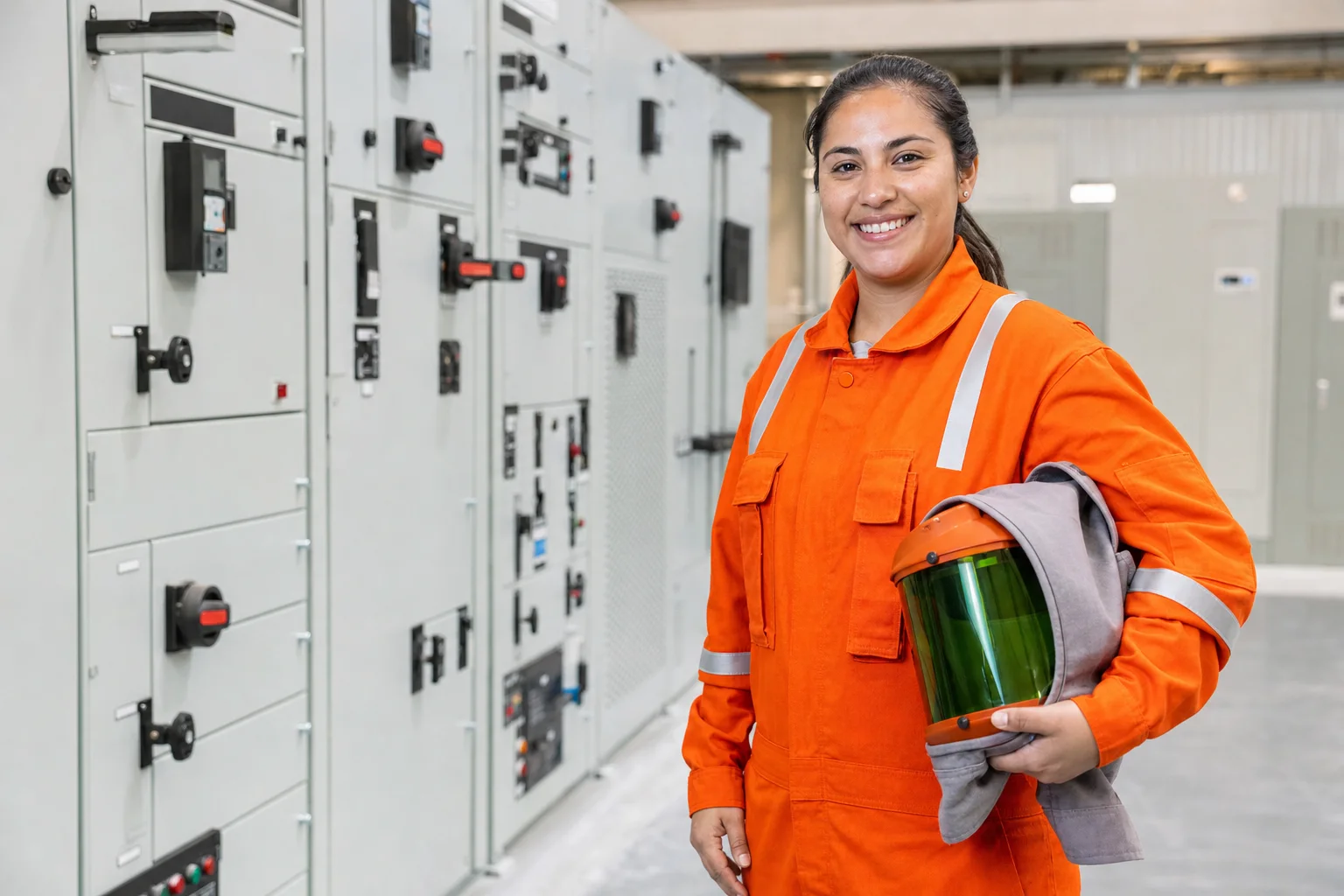
What does the job look like day to day?
A construction electrician installs new systems. A maintenance electrician inherits them and keeps them working. BLS notes that maintenance is often harder than new installation, because the wiring is already buried and the faulty part can be hard to reach. In a plant that means motors, motor starters, variable frequency drives, control panels, PLC inputs and outputs, sensors, lighting and the distribution gear that feeds all of it.
A typical shift mixes planned work with breakdowns. Planned work covers inspections, thermal scans, cleaning and tightening, and swapping worn parts before they fail. Breakdowns are the calls that matter most: a conveyor stops, a drive faults, a line goes down, and production waits on you. You read the prints, check voltage and current with a meter, follow the control logic, find the failed part, and get it running safely.
Motors, drives and PLCs
Motors are the backbone of most plants, so you will spend a lot of time on them. You check windings and connections, test starters and overloads, and trace why a motor trips or will not start. Drives add another layer. You learn to read fault codes, check parameters and tell a drive problem from a motor or wiring problem.
PLCs run the machines. Most plants expect maintenance electricians to read ladder logic, go online with a processor to watch inputs and outputs change, and pin down whether a fault sits in a field device, the wiring or the program. Programming changes are often handled by controls staff, but reading logic well is what makes a maintenance electrician fast at troubleshooting.
Shifts, plants and working conditions
Plants that run around the clock need electricians on every shift, so expect nights, weekends and on-call rotations, especially early on. BLS says electricians' schedules may include evenings and weekends, and that overtime is expected during scheduled maintenance. Plant shutdowns and outages are the heaviest weeks of the year.
Employers include auto and food plants, steel and paper mills, chemical plants, refineries, warehouses and distribution centers, water treatment plants and hospitals. BLS counts manufacturing as about 6 percent of electrician jobs. Factory work is noisy and BLS notes hearing protection is required, along with the usual shock, burn and fall hazards of the trade.
Moving from construction into maintenance
Most maintenance electricians start in construction or come up through an apprenticeship. A licensed journeyman already has the code knowledge and wiring skills. What you need to add is controls: motor control circuits, drives and PLC troubleshooting. Night classes, manufacturer training and a few months working beside a senior plant electrician close most of that gap.
Expect plant interviews to test troubleshooting more than installation. Be ready to walk through how you would find a fault in a three-wire start-stop circuit or a motor that trips on overload. In licensing states, keep your journeyman license active, because it keeps your options open in both construction and plant work.
Pay
USD a year, before tax. Figures cover all electricians, from U.S. Bureau of Labor Statistics OEWS May 2025 data adjusted to 2026 with a wage index. State figures are modeled estimates. Shift premiums, overtime during shutdowns, union contracts and controls skills push plant pay higher. Refer to the Electricians salary guide for figures from live adverts.
What you need
- High school diplomaBLS lists a high school diploma or equivalent as the entry-level education for electricians.
- ApprenticeshipMost electricians train through a 4 or 5 year apprenticeship, with about 2,000 hours of paid on-the-job training each year plus classroom instruction.
- State license where requiredMost states license electricians and require a code-based exam. Texas and Minnesota offer a maintenance electrician license aimed at this work.
- Controls knowledgePlants expect you to troubleshoot motor control circuits, drives and PLC inputs and outputs using prints and a meter.
- Shift availabilityExpect nights, weekends, on-call duty and overtime during planned shutdowns.
- Color visionBLS notes electricians must identify wires by color.
State by state
| Texas: Maintenance Electrician | TDLR requires 8,000 hours of on-the-job training under a Texas Master Electrician or Maintenance Electrician, a $20 application fee and a passing exam. The holder performs maintenance work under the general supervision of a Master Electrician, and licenses renew every year. |
|---|---|
| Texas: Journeyman Industrial Electrician | This limited TDLR license covers electrical work only at chemical plants, petrochemical plants, refineries, gas plants, pipelines and oil and gas operations. It requires 8,000 hours as a licensed apprentice under a Master Electrician, and the experience does not count toward a Master Electrician license. |
| Minnesota | The Department of Labor and Industry maintenance electrician license needs 48 months of experience, with at least 24 months maintaining and repairing electrical equipment. Up to 12 months of process control work and up to one year for an approved two-year technical course can count. |
How to get there
- Before year 1Finish high schoolTake math and any shop or electronics classes on offer.
- Year 1-4Start an apprenticeshipEarn about 2,000 paid hours a year while taking classes in theory, code, prints and safety.
- Year 4-5Get licensedPass your state's journeyman exam, or a maintenance electrician exam where one exists.
- Year 3-6Build controls skillsLearn motor control, drives and PLC troubleshooting through courses and plant experience.
- Year 5 onMove into a plantStart on an off shift, learn the equipment and work toward a day shift or lead role.
- Year 8 onAdvanceMove up to lead electrician, maintenance supervisor, controls technician or master electrician.
Open now on ElectricalRoles.com


Questions people ask
Do industrial maintenance electricians need a license?
It depends on the state. Texas requires anyone doing non-exempt electrical work to be licensed and offers a Maintenance Electrician license after 8,000 supervised hours and an exam. Minnesota has a maintenance electrician license that requires 48 months of experience.
Is maintenance work harder than construction work?
It is different. BLS notes that maintaining existing systems is often more complicated than new installation because wiring is less accessible, so diagnosing faults is the main skill.
Do I need to know PLC programming?
Most plants want you to read ladder logic and watch inputs and outputs online to find faults. Writing and changing programs is often left to controls staff, though strong maintenance electricians pick it up over time.
What shifts do plant electricians work?
Plants that run continuously staff electricians on days, nights and weekends, often with on-call rotations. BLS says electricians' schedules may include evenings and weekends, and that overtime is expected during scheduled maintenance.
Does Texas journeyman industrial experience count toward a master license?
No. TDLR says Journeyman Industrial Electrician experience cannot be used toward a Master Electrician license. The license is limited to chemical, refinery, gas, pipeline and oil and gas sites.
Sources
- U.S. Bureau of Labor Statistics: Electricians, Occupational Outlook Handbook
- Texas Department of Licensing and Regulation: Maintenance Electrician license
- Texas Department of Licensing and Regulation: Journeyman Industrial Electrician license
- Texas Department of Licensing and Regulation: Electricians at a Glance
- CareerOneStop: Minnesota Maintenance Electrician license
- O*NET OnLine: Industrial Machinery Mechanics 49-9041.00