What does a low voltage technician do day to day?
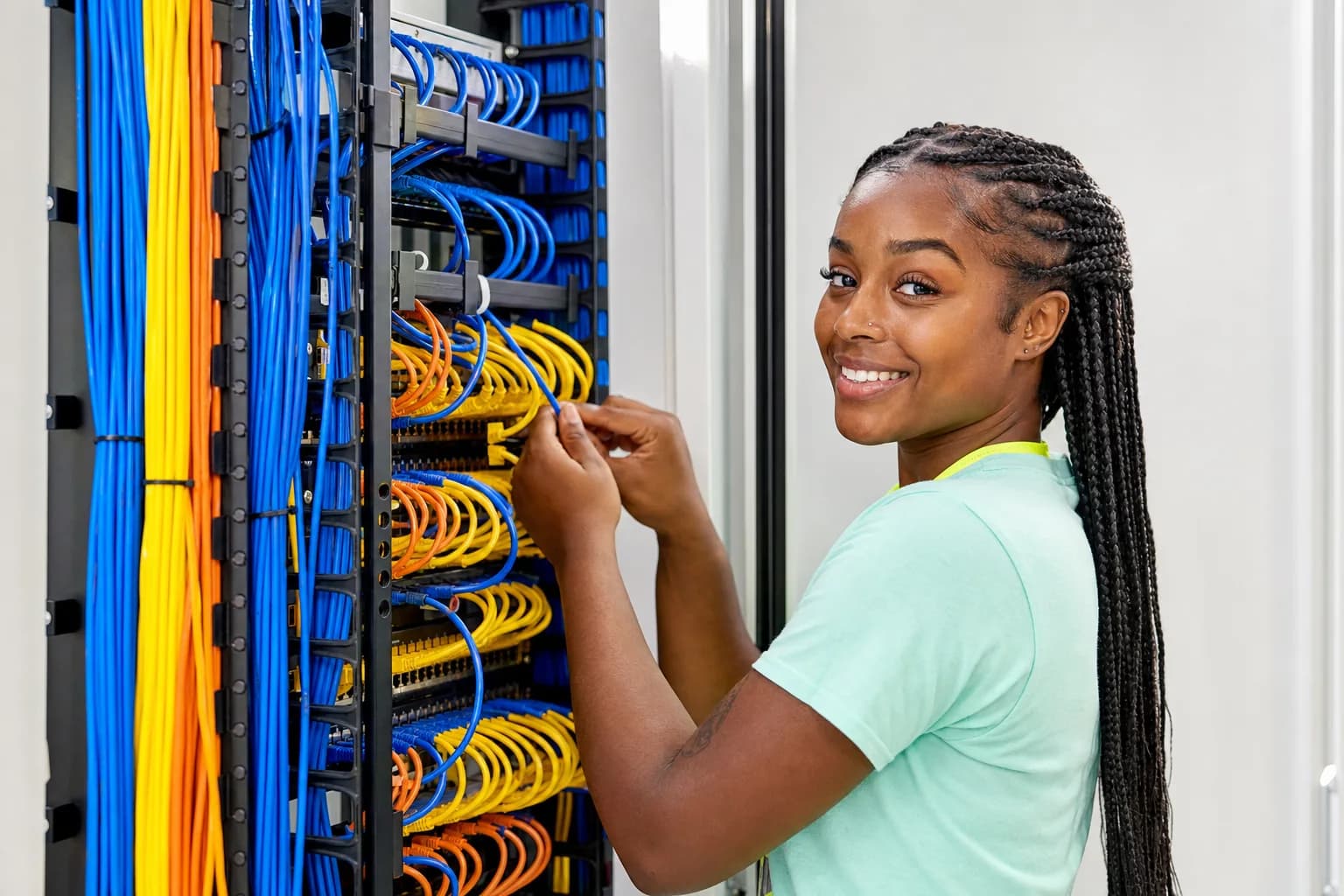
You run the cable that buildings think and talk with. That means pulling copper and fiber, building out telecom rooms, mounting racks and cable tray, terminating jacks and patch panels, and testing every link before you hand it over. On security and access control jobs you hang cameras, card readers, door hardware and the panels behind them. On AV jobs you wire speakers, displays and control systems in conference rooms, schools and churches.
California's licensing board gives a fair picture of the scope. Its C-7 class covers telephone, sound, cable TV, closed-circuit video, satellite antennas, instrumentation and temperature controls, and low voltage landscape lighting. It specifically leaves out low voltage fire alarm systems, which is a separate specialty. Telecom-side work also involves service calls: finding the dead port, repairing damaged runs, and keeping records of what you installed.
Which BICSI credentials matter?
BICSI is the main credentialing body for structured cabling, and many contractors ask for its cards. The ladder starts with the entry-level Installer 1 (INST1) certificate and its hands-on training program. Next come Installer 2, Copper (INSTC) and Installer 2, Optical Fiber. For INSTC, the fastest route is six months of full-time structured cabling experience plus BICSI's instructor-led Installer 1 program. Experience can come from the job, a trade school or an apprenticeship.
Without BICSI training, INSTC requires two years of field experience and at least 35 hours of documented continuing education in copper cabling. A middle option is one year of copper experience plus BICSI's hands-on copper course. The top installation card is BICSI Technician (TECH). BICSI recommends three years of current installation experience before its Technician course, which covers work like troubleshooting fiber with an OTDR. The TECH exam is registered and paid for separately from the course.
Do you need a state license for low voltage work?
It depends on the state, and the rules are not uniform. Washington treats it as electrical work. You need an L&I electrician certificate in the Limited Energy System (06) specialty, which requires 4,000 hours of supervised experience as a registered trainee, at least 75% supervision, and 48 hours of basic classroom instruction. Certificates renew every three years. Several IBEW-affiliated JATCs in Washington run 06 limited energy apprenticeships.
Minnesota's Department of Labor and Industry licenses power limited technicians. You need at least 36 months of experience, with at least 12 months spent actually wiring and installing technology circuits. In California, a contractor doing this work needs the CSLB C-7 license, which calls for four years of journey-level experience plus a business and law exam and a trade exam. Many other states regulate low voltage work through their electrical boards or local jurisdictions.
What does the work pay, and what is the outlook?
Our modeled figures put the U.S. middle of the market at about $53,700 to $84,600 a year, with a median near $66,100. The Bureau of Labor Statistics reports a closely matching 2025 median of $66,200 for telecommunications technicians. High-cost states with licensing, such as California and Washington, sit higher. Fiber splicing, testing, and union work tend to push pay toward the top of the range.
BLS projects telecommunications technician employment to fall 3% from 2025 to 2035. It still expects about 20,300 openings a year as people retire or move on. Demand varies by sector. Commercial construction, data centers and security integration hire differently than telephone and cable carriers do.
Pay
USD a year, before tax. Modeled from U.S. Bureau of Labor Statistics OEWS May 2025 data for data cabling and low voltage work, moved to 2026 with a wage index. State figures are modeled estimates. Ranges show the 25th to 75th percentile. Licensing, fiber and testing skills, and union coverage move the figure. Refer to the Data Cabling & Low Voltage salary guide for figures from live adverts.
What you need
- EducationBLS says telecom technicians typically need at least a high school diploma or equivalent. Most of the skill is learned on the job or in an apprenticeship.
- Physical abilityBICSI's Technician course lists the basics: telling wire colors apart, fine hand work, standing for long periods and climbing ladders.
- BICSI Installer 2, CopperNeeds six months to two years of verified structured cabling experience, depending on whether you complete BICSI training or log 35 hours of continuing education.
- BICSI TechnicianBICSI recommends three years of current installation experience before its Technician course. The exam is booked separately.
- State license where requiredWashington requires an 06 Limited Energy certificate, Minnesota licenses power limited technicians, and California contractors need a C-7 license.
State by state
| Washington | Low voltage work requires an L&I Limited Energy System (06) electrician certificate. You qualify with 4,000 hours as a supervised trainee plus 48 hours of basic classroom instruction, then pass the exam and renew every three years. |
|---|---|
| Minnesota | The Department of Labor and Industry licenses power limited technicians. You need at least 36 months of experience, with at least 12 months of hands-on technology circuit wiring. Up to 12 months of credit is allowed for an approved two-year electrical program. |
| California | Contractors installing energy-limited systems up to 91 volts need the CSLB C-7 Low Voltage Systems Contractor license. It requires four years of journey-level experience and passing a business and law exam and a trade exam. Low voltage fire alarm work is excluded from C-7. |
How to get there
- Year 0-1Start as a cabling helper or installerPull cable, dress racks and learn termination and labeling under a lead. In licensing states such as Washington, register as an electrical trainee first so your hours count.
- Year 0-1Take BICSI Installer 1 trainingThe entry-level certificate program. Completing it shortens the experience you need for Installer 2.
- Year 1-2Earn Installer 2, Copper or FiberQualify with six months of field experience plus the BICSI Installer 1 program, or with more experience and continuing education.
- Year 2-3Get your state certificate where requiredIn Washington, sit the 06 Limited Energy exam after 4,000 hours. In Minnesota, the power limited technician license requires 36 months of experience.
- Year 3-4Earn BICSI TechnicianBICSI recommends three years of experience first. The credential covers complex installs and fiber troubleshooting, and it positions you to lead crews.
- Year 4+Lead, supervise or contractRun jobs as a lead or foreman. In California, contracting requires a C-7 license after four years of journey-level experience.
Open now on ElectricalRoles.com


Questions people ask
Is a low voltage technician the same as an electrician?
No. Low voltage technicians work on energy-limited systems such as data, security, access control and AV rather than light and power wiring. Some states, like Washington, still treat it as a specialty electrician certificate, so you are licensed under the electrical rules for a narrower scope.
Can I start with no experience?
Yes. Many contractors hire helpers to pull cable, and BICSI's Installer 1 is an entry-level certificate. In states that certify the work, you need to register as a trainee before your hours count.
How long does it take to get licensed in Washington?
The 06 Limited Energy specialty requires 4,000 hours of supervised work experience, roughly two years full time. You also need 48 hours of basic classroom instruction before you can test.
Does California's C-7 license cover fire alarm work?
No. The CSLB C-7 classification covers energy-limited systems up to 91 volts but specifically excludes low voltage fire alarm systems. Those are handled under a separate classification.
Is low voltage work growing?
BLS projects telecommunications technician jobs to decline 3% from 2025 to 2035. It still expects about 20,300 openings each year. Work tied to commercial construction, data centers and security integration does not always follow the carrier-side trend.
Sources
- BICSI: Installer 2, Copper (INSTC) certification
- BICSI: Technician training (TE350)
- CSLB: C-7 Low Voltage Systems Contractor
- O*NET License Finder: California Low Voltage Systems Contractor
- Washington L&I: Electrician certification
- Washington L&I: Electrical apprenticeships list
- O*NET License Finder: Minnesota Power Limited Technician
- BLS Occupational Outlook Handbook: Telecommunications Technicians