

What Does a Low Voltage Technician Do? Pay, Certs & Outlook

Low voltage techs wire the fiber, data, fire alarm and security systems inside every AI data center. Here's the job, the pay, the licenses and how to get in.
Walk into a new AI data center while it's being fitted out and you'll see the big electrical gear first: switchgear, busway, transformers, generators. Look up, though, and you'll see something just as impressive. Mile after mile of fiber and copper running through overhead trays, bundled, labeled and terminated with the kind of neatness that would make a watchmaker proud.
That's low voltage work, and right now it's one of the most underrated career paths in the whole electrical industry. Let's go through what a low voltage technician actually does, what it pays, which licenses and certifications matter in the US and Canada, and why I think the outlook is so strong.
What a low voltage technician does
A low voltage technician installs, tests and maintains the power-limited systems inside buildings: the circuits that carry data, signals and control rather than heavy power. Depending on the company, you might hear the role called a structured cabling tech, network cabling installer, fiber tech, fire alarm tech, security tech or limited energy electrician. The core of the job is the same.
On a typical project, a low voltage tech will:
- Install the pathways: cable tray, ladder rack, J-hooks, innerduct and sleeves through fire-rated walls.
- Pull and dress cable: Category 6A copper, single-mode and multimode fiber, and coax, often in very high counts.
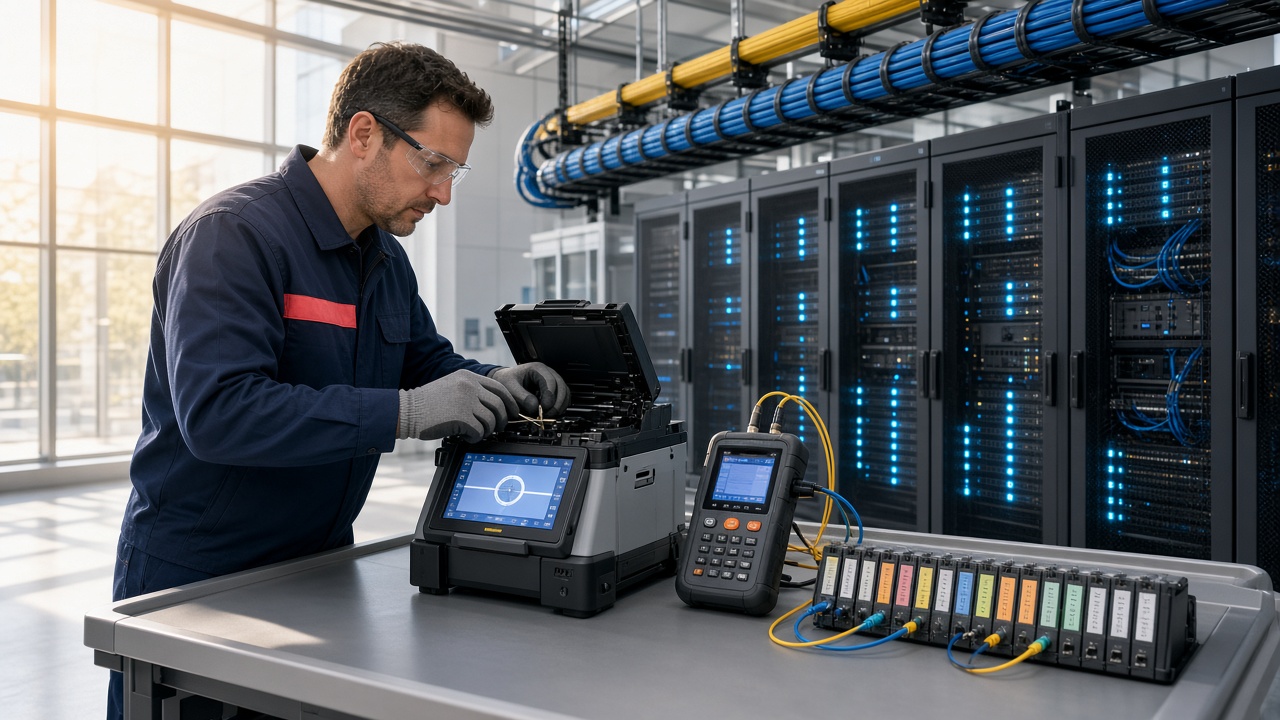
- Terminate and splice: punch-downs, patch panels, fiber connectors and fusion splicing.
- Test and certify: run certification testers and OTDRs, then produce test reports that prove every link meets the standard.
- Label and document: as-built drawings and labeling so the next person can find any cable in seconds.
- Install and program systems: fire alarm devices and panels, access control, cameras, nurse call, paging, AV, Wi-Fi access points and building automation.
The "low voltage" label is a little misleading. You're not wiring 480-volt feeders, but you're working under real codes. In the NEC, power-limited circuits sit in Chapter 7 (including Article 725 for Class 2 and Class 3 circuits and Article 760 for fire alarm systems), and communications systems sit in Chapter 8. Fire alarm work also follows NFPA 72. Get the firestopping, separation from power conductors or circuit classification wrong, and an inspector will rightly fail it.
Where the work is
AI data centers are the big one
The demand here is staggering. BSRIA's Structured Cabling Worldwide 2026 report, covered by Data Centre Review, found that global structured cabling sales grew 21% in 2025 to $9.08 billion. Data center cabling grew 54%, and data centers now make up more than 41% of all structured cabling installed worldwide. The US was the standout, with sales up 44% year over year and 89% of the global increase.
AI clusters need far more fiber than traditional server rooms, because thousands of accelerators have to talk to each other at enormous speeds. Every one of those links has to be pulled, terminated, tested and documented by someone.
The hyperscalers know they're short of people. In April, Meta and CBRE launched LevelUp, a free, four-week fiber technician program designed to take people with no prior experience and prepare them for work on Meta's US data center construction sites. Meta says it operates or is building 27 data centers in the US.
Commercial buildings, hospitals, schools and campuses
Away from data centers, the steady work is in commercial and institutional buildings: offices, hospitals, universities, airports, stadiums and apartment towers. Every one needs data cabling, Wi-Fi, fire alarm, security and access control, and those systems get upgraded regularly. BSRIA notes that LAN cabling in the Americas grew 9% in 2025, driven by the US and Canada, and that Cat 6A has now overtaken Cat 6 in global sales.
Service and maintenance
Fire alarm and security systems need inspection, testing and maintenance for the life of the building. That's a strong option if you want regular hours and a home every night.
What it pays
Pay depends a lot on specialty and market, so here are a few real reference points.
The US Bureau of Labor Statistics tracks security and fire alarm systems installers, one of the main low voltage groups. Its May 2025 data shows a median wage of $60,070, with the middle half earning between about $47,820 and $73,690, and the top 10% earning more than $81,150. For comparison, the BLS median for electricians in the same survey was $63,190.
Data center work tends to pay more. Kelly's data center salary guide, as reported by Broadband Nation, lists telecom technicians at an average of $87,000, a Data Center Technician I at $68,000 and a Data Center Technician II at $92,000. The same guide says 53% of operators report difficulty finding qualified candidates.
My honest take: the entry-level wage can be lower than a traditional electrical apprenticeship, but the ceiling is higher than most people realize. Techs who can splice and test fiber, lead a crew, program fire alarm panels or read a design and fix it on the fly are well paid. Plus, data center projects often come with plenty of overtime and per diem for travel.
Licenses and certifications
This is where low voltage gets confusing, because the rules are set state by state and province by province. Always check with your own state or provincial authority. Here are some examples to show how different they are.
State licensing in the US
- Washington has a Limited Energy System (06) specialty covering telecommunications, fire protection signaling, intrusion alarms, energy management and controls, lighting controls, sound systems and similar low-energy circuits, with strict limits on touching line voltage.
- Minnesota licenses Power Limited Technicians for Class 2, 3 and 4 "technology circuits". A PLT has to work as a W-2 employee of a licensed contractor or registered employer, and unlicensed workers can do the work under a PLT's supervision.
- California has the C-7 Low Voltage Systems contractor license at the business level.
- Many other states license fire alarm or security work separately, and some have no low voltage license at all.
Industry certifications
These matter wherever you work:
- BICSI credentials (Installer 1, Installer 2 Copper or Optical Fiber, Technician, and the RCDD for designers) are the best-known structured cabling path in North America.
- NICET certification in Fire Alarm Systems (Levels I to IV) is widely asked for in fire alarm design, installation and inspection roles, and many jurisdictions and employers expect it.
- Manufacturer certifications for cabling systems, fire alarm panels and access control platforms often decide who gets to work on warrantied installations.
- Fiber certifications that cover splicing and OTDR testing are fast becoming the most valuable add-on for data center work.
Canada
In Ontario, Network Cabling Specialist is a recognized trade with its own apprenticeship through Skilled Trades Ontario: about 4,600 hours in total, 4,000 on the job and 600 in school, covering copper and fiber terminating and splicing, codes, testing and networking. It's a non-compulsory trade with a certifying exam that earns you a Certificate of Qualification. Other provinces handle low voltage and fire alarm work differently, so check with your provincial apprenticeship authority.
How to get started
- Start as a helper or apprentice with a low voltage or integrated contractor. Many hire with no experience if you're reliable, careful and good with your hands.
- Look at fast-track programs. Short fiber programs like LevelUp, union and IEC or ABC low voltage tracks, and community college certificates can get you on site quickly.
- Go after BICSI Installer 1 early. It shows employers you take the work seriously.
- Learn fiber properly. Fusion splicing, cleaning, inspection and OTDR testing are the skills data center contractors are most desperate for.
- Be obsessive about documentation. Clean labeling and test reports are what separate a good tech from a great one on a hyperscale job.
- Decide on your lane. Data center construction, fire alarm, security and access control, AV and building automation are all solid. Pick one to get really good at, then add a second.
Where this role is heading
I'm genuinely bullish on low voltage. Buildings are getting smarter, and more of their systems now run over power-limited cabling. Power over Ethernet lights LED fixtures, cameras and access points, and the 2023 NEC added Class 4 fault-managed power (Article 726), which can deliver more power safely over smaller cabling. The line between "electrician" and "network tech" is blurring, and the people who understand both are going to be in huge demand.
To be fair about the numbers, the BLS projects a 3% decline for its broad telecommunications technicians category from 2025 to 2035, though it still expects about 20,300 openings a year. That category leans heavily on traditional telecom field service. Inside buildings, and especially inside data centers, the cabling numbers above tell a very different story. That's where I'd be putting my energy.
If you're an electrician who loves precision, a telecom tech looking for a new direction or someone completely new to the trades, low voltage is a smart way in. To see who's hiring right now, browse low voltage, fiber and electrical jobs on ElectricalRoles.com and set up an alert so the next role comes to you.