
What Does a BESS Technician Do? Pay, Certs & Outlook
What battery energy storage (BESS) technicians do, what they earn in the USA and Canada, the NABCEP ESIP path, and why storage jobs are booming in 2026.
A few years ago, almost nobody had "BESS technician" on their business card. Today it's one of the fastest-growing jobs in the electrical world, and I think it's one of the most exciting places a sparky can point their career.
BESS stands for battery energy storage system. Think rows of shipping-container-sized battery enclosures, inverters and transformers sitting beside a solar farm, a substation or an old power plant site. They soak up electricity when it's cheap and plentiful, then push it back onto the grid when demand peaks. Someone has to build, commission, maintain and fix all of that equipment. That someone is the BESS technician.
This is the latest in my "what does a…" series. We've already covered the solar PV installer, the testing and commissioning electrician and the substation technician. The BESS tech borrows a little from all three, but it's very much its own trade now.
Why this role is booming
The numbers are huge. SEIA and Benchmark Mineral Intelligence reported this week that the US installed 14.3 GWh of new energy storage in Q3 2026, taking the total for the first nine months of the year to 48.3 GWh, up 20% year over year. Cumulative US storage has passed 200 GWh, and the forecast for 2030 has been raised to 708 GWh. Texas led utility-scale deployment through Q3 with 12.3 GWh, followed by Arizona and California, and 11 states had already beaten their annual records with a quarter still to go.
You can see it in real projects. Alabama Power just announced that its Gorgas Battery Facility, the state's first utility-scale battery plant, is serving customers. It has 92 Tesla Megapacks and up to 150 MW of storage, and crews installed nearly 35 miles of cable over more than 108,000 work hours. It came in six months ahead of schedule.
Canada is moving fast too. On November 6, Ontario announced three new battery projects in Vaughan and Guelph, adding 80 MW. The province says that three years ago it had just 228 MW of energy storage, mostly at a single pumped storage facility, and that it has now secured nearly 3,000 MW of battery storage through its procurements.
Every one of those megawatts needs skilled hands, not just to build it but to keep it running for the next 15 to 20 years. That long tail of operations and maintenance work is what makes this such a solid career bet in my eyes.
What a BESS technician actually does
The role varies depending on whether you're on the construction side or the operations side, but the core is the same: safely working on high-energy DC and AC equipment.
Pearce, a large operations and maintenance provider, is currently hiring for Solar O&M BESS Technician roles, and its job description is a great real-world snapshot. Core duties include troubleshooting and preventive maintenance on BESS equipment, performing lockout/tagout as an authorized person, and running daily safety and task planning with job hazard and risk assessments. It also covers working with vendors and customers, and supporting or supervising site work with a focus on safety, quality and efficiency.
In practice, a typical week might look like this:
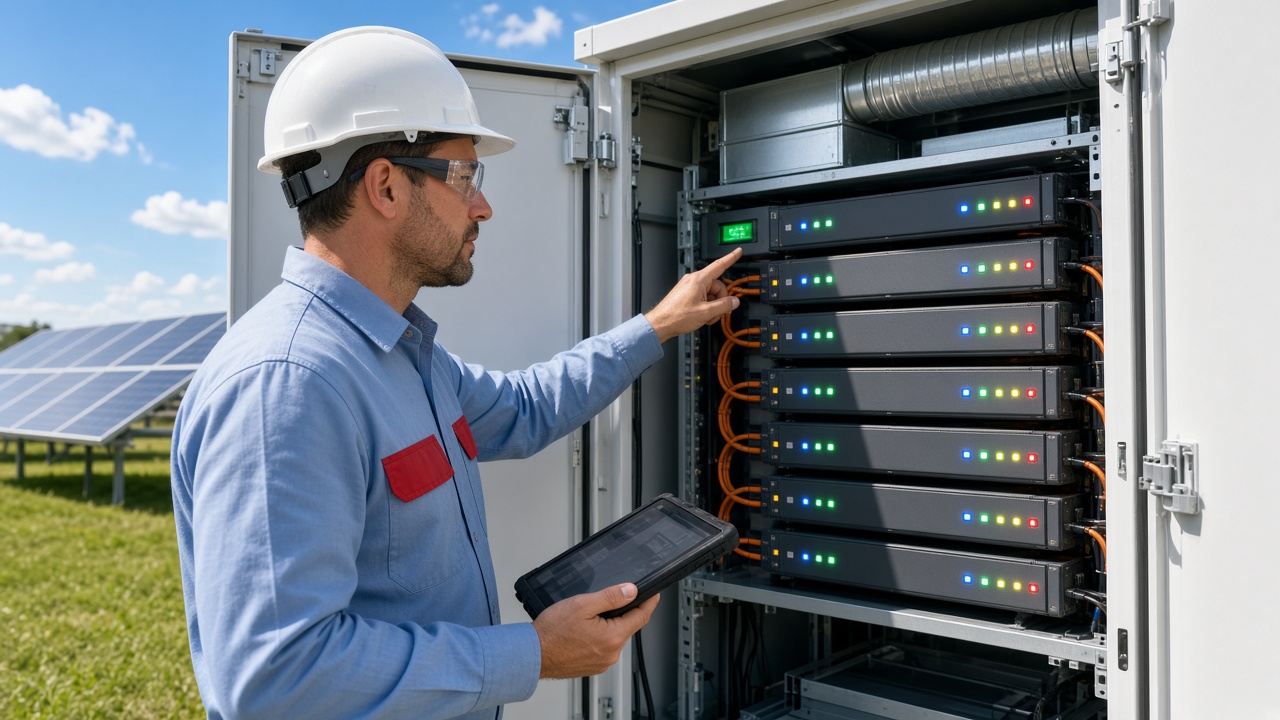
- Preventive maintenance. Inspecting enclosures, checking torque on connections, cleaning filters, looking at cooling and HVAC systems, and making sure fire detection and suppression equipment is ready.
- Troubleshooting. A rack drops offline, an inverter throws a fault, or the battery management system reports a cell imbalance. The tech works out whether it's a sensor, a communications link, a cooling issue or a real hardware failure.
- Lockout/tagout and switching. Isolating equipment safely before anyone touches it. With batteries, this matters even more, because stored energy doesn't disappear when you open a breaker.
- Commissioning. On new builds, checking wiring, testing protection, verifying communications with the site controller and bringing systems online step by step.
- Data and software. Reading alarms and trends in monitoring platforms, updating firmware and documenting everything. This is a very tech-forward trade.
- Working with OEMs and customers. Coordinating warranty work with manufacturers and keeping site owners informed.
The skills employers want
Pearce's listing asks for 3 to 4+ years of electrical experience with electrical systems and components, prefers 3 to 4+ years in renewable energy, and lists OSHA 10, OSHA 30 and NFPA 70E as preferred certifications. It also stresses safety, attention to detail and strong written and verbal communication.
I'd add a few more from what I see across the industry:
- Solid AC and DC fundamentals. Batteries live in the DC world, the grid lives in the AC world, and the inverter sits between them. Understand both.
- Code knowledge. In the USA, NEC Article 706 covers energy storage systems, and fire codes such as NFPA 855 shape how sites are laid out and protected. Knowing why the rules exist makes you a better tech.
- Comfort with laptops. Battery management systems, SCADA screens and OEM software are part of the daily toolkit.
- A safety-first mindset. Arc flash, stored energy and thermal events are real hazards. The best BESS techs are calm, methodical and never rush.
How much do BESS technicians earn?
There isn't a dedicated government wage category for BESS technicians yet, so I'll give you honest reference points rather than one made-up number.
Real job ads. Pearce lists $35 to $60 an hour for its New York-area BESS technician role and $30 to $42 an hour for a similar role around Laredo, Texas, depending on experience. The company also mentions possible extras such as performance bonuses, tool and fuel stipends, a company vehicle and per diem, plus a benefits package with a 401(k) match and tuition reimbursement. Expect regional differences like this everywhere: big-city and high-cost markets tend to pay more.
USA baseline. Most BESS techs come from an electrician background. The Bureau of Labor Statistics puts the median annual wage for electricians at $63,190 ($30.38 an hour) in May 2025, and projects 9% employment growth from 2025 to 2035, much faster than average. Storage specialists with commissioning and troubleshooting skills often sit above that median.
Canada baseline. Job Bank's wage data for electricians (NOC 72200) shows a national median of $37.00 an hour and a high of $50.00, with Québec's median at $42.00 and Alberta's at $39.20. Job Bank also reports that 89% of workers in the occupation receive at least one non-wage benefit.
How to become a BESS technician
The good news: there's no single gatekeeper, and there are several ways in.
1. Start with an electrical foundation. An electrical apprenticeship, a technical college program or military electrical training is the most common starting point. In Canada, that usually means working toward your construction or industrial electrician certification. If you're brand new, my guide to starting an electrical apprenticeship is a good first read.
2. Get your safety tickets. OSHA 10 and OSHA 30, NFPA 70E (or CSA Z462 in Canada) and lockout/tagout training are what employers look for first.
3. Get close to solar or storage work. Many techs move across from solar O&M, substation work or data center UPS maintenance, because the skills overlap heavily.
4. Go for the NABCEP ESIP. The NABCEP Energy Storage Installation Professional certification is the recognized credential for this work. To apply you need OSHA 30 (or a state or provincial equivalent), 58 hours of advanced energy storage training, proof of a decision-making role on storage projects, and six project credits from projects completed in the last two calendar years. A system of 1 to 80 kWh earns 1 credit, 81 to 999 kWh earns 2, and 1 MWh and up earns 3. Active NABCEP PV Installation Professionals get 18 non-accredited hours toward the 58. The exam is available in English and Spanish.
5. Pick up OEM training. Battery and inverter manufacturers run their own training programs, and having those on your résumé can make you instantly useful on a site.
My honest take on the outlook
I'm very bullish on this role, and here's why. A battery plant isn't a one-and-done construction job. Once it's built, it needs inspection, maintenance, software updates, repairs and eventually augmentation for years. As storage capacity climbs from hundreds of gigawatt-hours toward the forecasts, that O&M workload grows with it.
To be realistic: some roles involve a lot of travel, sites can be remote and hot in summer, and you'll occasionally work rotating shifts. Pearce's own listings mention possible rotating shifts and varied climates. But if you like problem-solving, technology and being part of something genuinely new, the trade-offs are well worth it.
My advice if you're interested
- Learn DC properly. Most electricians grow up on AC. Getting confident with DC systems, battery chemistry basics and inverters will set you apart quickly.
- Treat safety as your brand. Your reputation in storage is built on clean LOTO, careful switching and good paperwork.
- Start logging projects now. If ESIP is your goal, track every storage project you work on, including its size and your role, so you're ready to apply.
- Follow the build-out. Texas, Arizona, California and Ontario are big markets today, and states from Alabama to Michigan are catching up fast.
- Stay curious about software. The techs who can read the data as well as hold a meter are the ones who become leads.
Battery storage is reshaping how North America keeps the lights on, and BESS technicians are right at the heart of it. If that sounds like your kind of work, check out the latest electrical and energy storage jobs across the USA and Canada.