

What Does an Electrical Designer Do? Pay, VDC Skills & Outlook
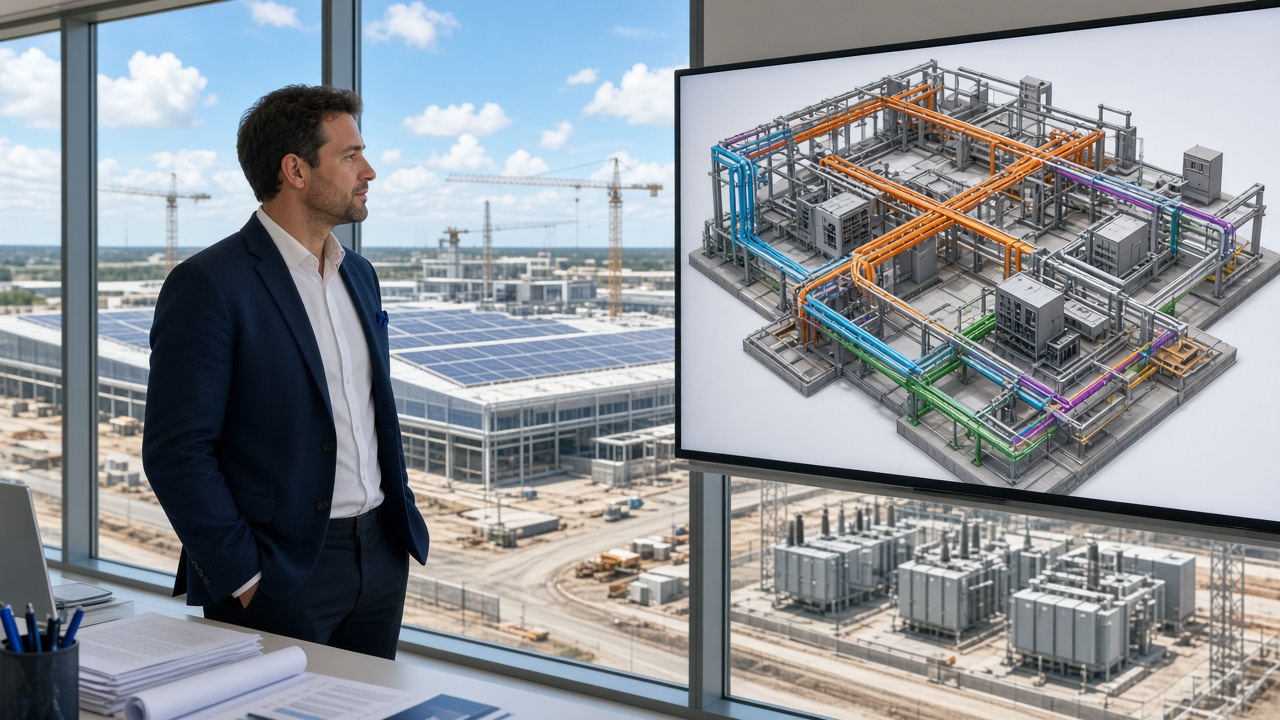
Electrical designers turn engineering into buildable 3D models for data centers and the grid. Here's what they do, what they earn and how to get into the role.
If you've ever walked a data center under construction and seen thousands of feet of cable tray, busway and conduit fit together perfectly, you've seen an electrical designer's work. You just didn't see the person who did it.
Electrical designers, and the virtual design and construction (VDC) specialists who've grown out of the role, are the people who turn an engineer's intent into something a crew can actually build. In 2026 the job looks very different from the old picture of a drafter hunched over AutoCAD. It's 3D, it's collaborative, it feeds straight into prefabrication shops, and on big projects it's one of the roles everything depends on.
This is the latest in my series on what each electrical role actually does. If you're a field electrician wondering about a less physically demanding path, or a student who likes both tech and the trades, this one's for you.
What an electrical designer actually does
At its core, the job is turning electrical design into accurate, buildable documents and models. Depending on where you work, that looks like one of two things.
At an engineering firm (the design side), you'll work alongside electrical engineers to produce the drawings that go out for permit and bid: power plans, lighting layouts, one-line diagrams, panel schedules, riser diagrams and details. The Bureau of Labor Statistics describes electrical drafters as the people who prepare the wiring diagrams that workers use to install and repair electrical equipment in power plants, distribution systems, and residential and commercial buildings.
At an electrical contractor (the build side), which is where much of the exciting growth is, you take those engineering drawings and model exactly how everything will be installed. That's what VDC means in practice:
- Building a detailed 3D model of conduit, cable tray, busway, gear and supports, usually in Revit or a similar BIM platform.
- Clash detection: coordinating your model with mechanical, plumbing, fire protection and structure so the duct and the cable tray aren't fighting for the same space on site.
- Producing spool drawings and prefab packages so assemblies can be built in a shop and dropped into place.
- Pulling quantities from the model for estimating and purchasing.
- Field layout support, often with robotic total stations that put model points straight onto the slab.
On a large data center, the electrical model can be the single source of truth that the estimator, the prefab shop, the foreman and the commissioning team all rely on.
A typical week
A realistic week for a contractor-side electrical designer might look like this:
- Monday: Coordination meeting with the general contractor and the other trades. You walk through clashes in the federated model and agree who moves what.
- Tuesday and Wednesday: Modeling. Routing feeders from the switchgear to the UPS rooms, laying out cable tray in the data halls, adding hangers and supports.
- Thursday: Building prefab packages for the shop, such as multi-conduit racks, so they can be built in a controlled environment rather than on a ladder.
- Friday: Site visit. Checking that what's going in matches the model, answering questions from the foreman, and capturing as-builts.
It's mainly a desk job, but the best designers spend real time on site. The BLS notes that drafters spend most of their time in an office but may visit jobsites to collaborate, and in the electrical contracting world I'd say those site visits are where you build your credibility.

What it pays
Here are the real numbers.
USA: The BLS reports a median annual wage of $76,870 for electrical and electronics drafters in May 2025, the highest of the drafting specialties (mechanical drafters were at $71,550 and architectural and civil drafters at $66,150). Across all drafters, the top 10% earned more than $102,590. Drafters working in construction had a higher median ($70,640) than those in architecture and engineering services ($68,090). Source: BLS Occupational Outlook Handbook.
Canada: Job Bank lists the national median for drafting technologists and technicians (NOC 22212, which covers electrical draftspersons) at $31.79 an hour, with a high of $48.38. Provincial medians range from $26.91 in Prince Edward Island to $36.00 in Newfoundland and Labrador. Source: Job Bank.
My honest read is that the title "drafter" undersells what strong VDC people do. Designers who can run coordination on complex mission-critical projects, lead a team of modelers or manage prefab workflows tend to move into VDC manager or project roles, and the pay moves with them. The official numbers are the floor, not the ceiling.
The outlook: be honest about the shift
I'm not going to sugarcoat the government data. The BLS projects employment of electrical and electronics drafters to decline about 3% from 2025 to 2035, from 18,900 to 18,200 jobs. Across all drafters it still expects about 14,400 openings a year, mostly from people retiring or changing careers.
So what's happening? I think the work is changing, not disappearing. Pure 2D drafting, redrawing an engineer's markups line by line, is exactly the sort of task that better software and AI tools are absorbing. What's growing is the higher-skill version of the job: 3D coordination, prefab design, model-based estimating and digital field layout. A lot of that work ends up under titles like "VDC coordinator" or "BIM specialist" rather than "drafter," which is part of why the official count looks flat.
Industry is putting money behind it. Google has just committed $4 million to NECA and ELECTRI International to expand leadership training for electrical contractors, and virtual design and construction is one of the named focus areas, alongside preconstruction, superintendent leadership and commissioning. The first expanded cohorts are expected to start in the second quarter of 2027. When one of the biggest data center builders on the planet funds VDC training for the people who build its facilities, I take that as a strong signal of where the role is going.
My advice: don't aim to be a drafter. Aim to be the person who owns the electrical model on a big, complex project. That person is in demand.
How to get into electrical design
There are two well-worn paths in, and both work.
Path 1: From school
The BLS says drafters typically need an associate degree or certificate from a community college or technical school, usually about two years full-time for an associate degree. Look for programs with real Revit and BIM content, not just AutoCAD. In Canada, look at a two- or three-year engineering technology diploma (electrical or building systems). Certification is optional, but the American Design Drafting Association runs certification exams in the US, and in Canada provincial technology associations offer technician and technologist designations.
Path 2: From the field
This is the one I'd shout about. Plenty of the strongest VDC people started out as electricians. They know how conduit actually gets bent, how much room a crew needs to pull wire, and what a foreman will curse at. That's knowledge you can't learn from software.
If you're a journeyperson or a senior apprentice who's good with computers:
- Tell your company you're interested. Many contractors would much rather train an electrician in Revit than teach a software person how buildings get wired.
- Learn Revit properly. There are plenty of online courses, and Autodesk offers certification exams.
- Volunteer for coordination meetings and prefab shop work.
- Keep your license current. Field credibility is your edge.
The skills that matter
- 3D modeling and BIM: Revit is the standard on most commercial and data center work, with AutoCAD still common for details and older sets.
- Code knowledge: NEC (or the CE Code in Canada) clearances, fill and support rules. A model that breaks code is worse than no model.
- Spatial thinking: seeing how a congested ceiling space will actually go together.
- Communication: much of the job is negotiating space with other trades without making enemies.
- Comfort with new tools: laser scanning, robotic layout and AI-assisted modeling and clash tools are all becoming part of the workflow.
Who's hiring
Demand is concentrated where projects are big and complex:
- Electrical contractors with mission-critical, healthcare or industrial work, especially those with in-house prefab shops.
- Engineering firms designing data centers, substations and renewable plants.
- Utilities and transmission developers, for substation physical design and protection drawings.
- Prefab and modular manufacturers building power skids and e-houses.
My take
Electrical design is one of the most underrated career moves in this industry. You get to work at the cutting edge of how buildings and grid infrastructure come together, with tools that would have looked like science fiction 15 years ago, and you stay closely tied to the trade. If you're a field electrician whose knees are starting to complain but whose brain is fully engaged, it's well worth a look.
The drafting title may be shrinking, but the need for people who can turn complex electrical systems into clean, buildable models is only growing. Get good at that and you'll have no shortage of options.
Want to see who's hiring now? Browse electrical jobs across the USA and Canada.