

What Does a Power System Operator Do? Pay, NERC Cert & Outlook
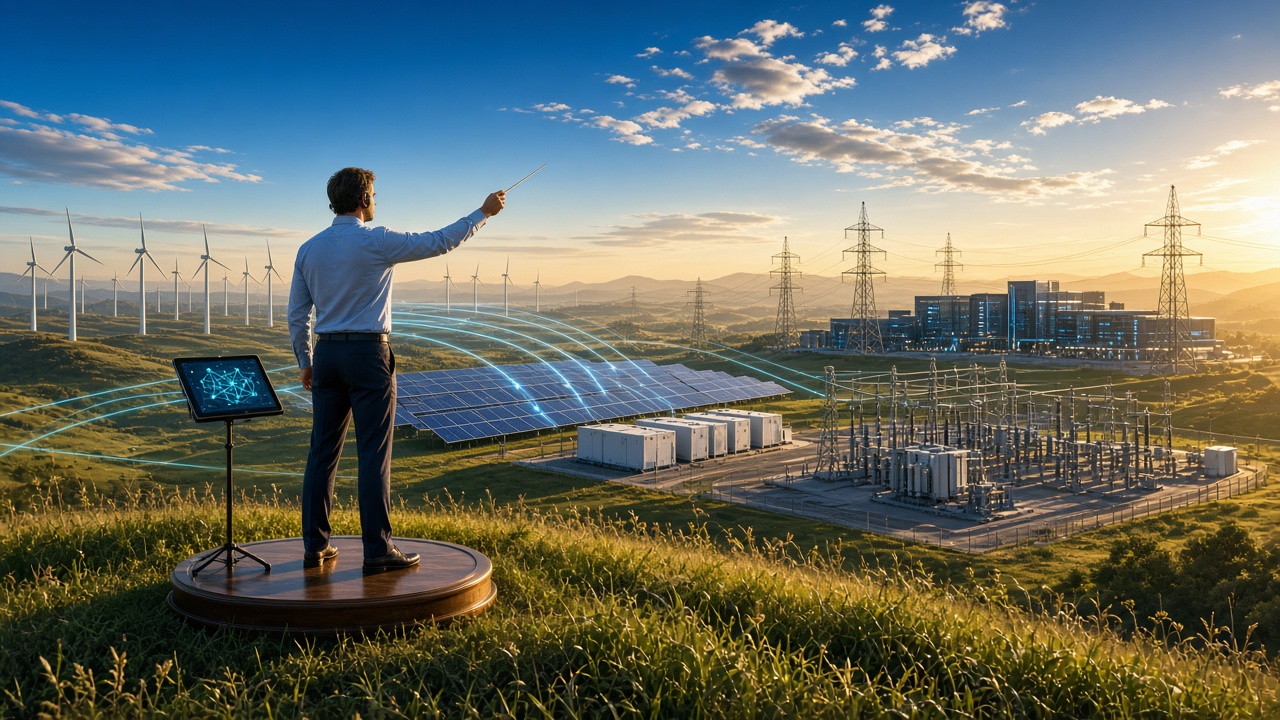
Power system operators run the grid 24/7 from control rooms. What the job involves, what it pays in the USA and Canada, NERC certification and how to get in.
Most of the careers in our "What does a ___ do?" series involve tools, ladders, conduit and a fair bit of dust. This one doesn't. A power system operator might never touch a breaker with their own hands, yet they decide when it opens and closes, and they keep the lights on for millions of people while doing it.
System operators (also called transmission system operators, grid dispatchers or control room operators) sit in utility and grid operator control centers around the clock, watching the high-voltage system in real time and acting when something changes. With utilities announcing record capital plans this month (I covered that in today's industry news), more generation, storage and transmission is about to come online than at any time in decades. All of it has to be operated by somebody. Here's what the job involves, what it pays, and how to get one.
What a power system operator actually does
The US Bureau of Labor Statistics groups this work under power plant operators, distributors and dispatchers, people who "control the systems that generate and distribute electric power." The grid side of that group, power distributors and dispatchers, manage the flow of electricity from plants to substations and on to customers.
A recent posting from Nebraska Public Power District for a Transmission System Control Operator Apprentice is a good, honest summary of the day job. Operators there monitor the 115 kV-and-above transmission system using an Energy Management System (EMS), prepare and issue switching orders for high- and extra-high-voltage lines and equipment, control voltage and reactive power, react to changes in load, and respond to emergencies like the loss of a line, substation or generator, all in line with NERC reliability standards.
In practice, that breaks down to:
- Monitoring flows, voltages and frequency across the network on huge video walls and multi-screen consoles.
- Switching: writing, checking and directing the switching orders that let field crews safely de-energize equipment for maintenance or construction. Every new substation that gets tied in passes through the control room.
- Balancing and coordination: working with neighboring utilities, generators and the regional grid operator to keep supply and demand matched.
- Emergency response: storms, equipment failures and unexpected outages, where calm, fast decisions matter most.
- Logging and compliance: documenting what happened and why, because operations are audited against NERC standards.

A modern grid control center: operators watch the high-voltage system in real time, around the clock.
A day (or night) in the life
This is a shift job, and you need to know that going in. ERCOT, which runs the Texas grid, is upfront that its operators must be able to work rotating day/night 12-hour shifts. Most control rooms run 24/7/365, so holidays, weekends and nights are part of the deal. In exchange, you usually get blocks of days off, strong pay and a genuinely important seat.
A typical shift starts with a handover from the outgoing crew: what's out of service, what switching is scheduled, what the weather and load forecast look like. Then it's a mix of routine monitoring, approving and directing planned switching for field crews, talking to neighboring control centers, and dealing with whatever the system throws at you. On a quiet night, it's focused and steady. On a stormy afternoon, it's intense teamwork.
What power system operators earn
This is one of the best-paid roles you can get into without a degree. In the BLS May 2025 data, power distributors and dispatchers earned a national median of $106,730 a year ($51.31 an hour). The middle half earned between $90,200 and $130,940, the bottom 10% earned $72,440 or less and the top 10% earned $154,270 or more. For the wider group of power plant operators, distributors and dispatchers, the median was $105,080.
Real postings back that up. NPPD lists a starting rate of $61.73 an hour for its transmission control operator apprentice role in Doniphan, Nebraska, plus an annual incentive program and a NERC certification premium once you're certified. That's more than $128,000 a year on a standard 2,080-hour basis before any overtime or shift premiums.
In Canada, Job Bank combines this work with stationary engineers under NOC 92100, "power engineers and power systems operators." The national median is C$49.23 an hour, ranging from C$30.00 to C$75.55, with medians of C$57.69 in Alberta and C$57.00 in Ontario, C$41.00 in British Columbia and C$37.50 in Quebec. Because that group mixes plant and grid roles, treat it as a ballpark; dedicated grid control room roles at big utilities and system operators often sit toward the upper end.
NERC certification: the ticket you'll need
Here's the bit most people outside the industry don't know. Under NERC's PER-003 standard, Reliability Coordinators, Transmission Operators and Balancing Authorities must staff their real-time operating positions with NERC-certified system operators. Anyone not yet certified has to work under the direct supervision of a certified operator at that desk.
According to NERC's System Operator Certification Program Manual, there are four credentials:
- Reliability Coordinator Operator (RC): 140 questions, 120 scored, cut score of 92.
- Balancing, Interchange and Transmission Operator (BT): 140 questions, 120 scored, cut score of 92.
- Transmission Operator (TO): 120 questions, 100 scored, cut score of 76.
- Balancing and Interchange Operator (BI): 120 questions, 100 scored, cut score of 76.
The exams are computer-based, multiple choice and delivered through Pearson VUE. A certificate is valid for three years, and to keep it you need continuing education hours: 200 for RC, 160 for BT and 140 for TO or BI, each including at least 30 hours on NERC Reliability Standards and 30 hours of simulation. NERC monitors operators in control centers across North America, so the credential carries on both sides of the border.
The good news? You usually don't need to pass it before you're hired. Most utilities train you for it.
How people actually get in
There are three common routes, and I like that they're open to very different backgrounds.
1. Trainee and development programs (no experience needed). ERCOT just posted its System Operator Development Program, a 12–14 month program for entry-level operators based in Taylor, Texas. The minimum is a high school diploma or GED, with "no minimum work experience required" (data analysis and math skills are preferred). New hires get six months to pass the NERC Reliability Coordinator exam, then rotate through outage coordination, operations support and training before on-the-job training on the control room floor and promotion to System Operator 1. Duke Energy runs a similar Associate Dispatcher – Transmission role at its Florida Energy Control Center, with a 12–15 month qualification program combining classroom, on-the-job training, field experience and simulation, and the NERC exam passed within the first year.
2. Moving inside from the field. This is the classic path, and it's a brilliant second act for experienced electrical people. NPPD's posting lists the experience it values: substation technician, line technician, power plant operator, telecommunications technician, distribution control center operations, engineering technician or system planning. If you've spent years switching, building or maintaining the system, you already understand what the operator is asking crews to do, which is exactly why utilities love promoting from the field.
3. Technical education. An associate degree in electrical or electronics technology (or a related bachelor's) shortens the experience requirement at many utilities. NPPD, for example, accepts an associate degree plus five years of related experience, or a high school diploma plus eight years, and lets a bachelor's substitute for up to three years.
There are also distribution-side roles (Duke, for instance, hires Distribution Control Center operators) that coordinate the lower-voltage network and outage restoration. They can be a great stepping stone toward transmission desks.
The outlook: small, stable and about to get busier
I'll give you the honest numbers. BLS counts only about 8,600 power distributors and dispatchers in the US and projects that to grow to 8,700 by 2035, with about two-thirds working in utilities. Across the wider operator group, BLS expects a slight decline but still about 3,400 openings a year, all from people retiring or changing careers.
So this isn't a mass-hiring trade like electricians. It's a small, specialized, well-paid club, and openings come up when experienced operators retire. That's precisely why I think it's worth a look right now. The grid these operators run is getting dramatically more complex: more batteries, more solar and wind, more 765 kV lines and huge new data center loads that can ramp up quickly. Duke alone says it has 5.2 GW of data center load under construction. Smarter software and AI-assisted forecasting will help operators see further ahead, but the regulations are clear that a certified human is accountable at the desk. That's a career with a long runway.
My practical advice if you want in
- Brush up on the fundamentals. Ohm's law isn't enough; get comfortable with three-phase power, real and reactive power, voltage control and how transmission systems are protected.
- Study for the NERC exam early. Even if your employer will train you, showing up already familiar with the reliability standards makes you stand out.
- Be honest with yourself about shifts. Twelve-hour rotating days and nights suit some people and not others. Talk to an operator before you apply.
- If you're in the field, raise your hand. Tell your supervisor you're interested in operations. Field experience is one of the strongest routes in.
- Watch the big employers. ISOs, large investor-owned utilities, public power districts and co-ops all hire operators, and openings often have short windows. NPPD's current posting, for example, closes November 30.
If you like the idea of being the calm voice coordinating a whole region's power on a busy day, this might be the most interesting electrical career you've never heard of. Keep an eye on our jobs board for control room, dispatcher and grid operations roles across the USA and Canada.