
Duke's $103B Plan, Fortis' Record Budget and the Utility Boom
Duke's $103B plan, a record C$32.2B from Fortis, Emera's $21.5B and more. What this wave of utility spending means for electricians, crews and contractors.
Every November, North America's big utilities sit down with investors and tell them how much they plan to spend over the next five years. It sounds dry. It isn't. Those capital plans are the closest thing our industry has to a published order book, and this year's round has been one of the most bullish I've seen.
In the last couple of weeks we've had Duke Energy reaffirm a $103 billion five-year plan, Fortis unveil the largest capital plan in its history, Emera roll out $21.5 billion of new spending, Southern Company signal its plan could climb toward $100 billion, and Entergy add another $1.5 billion to its own. (We covered AEP's $100 billion plan a couple of weeks ago, so I won't repeat it here.)
If you work with your hands or lead crews in this industry, this is the most important news of the month. Here's what's in the plans, and what I think they mean for your next five years.
Duke Energy: $103 billion and a faster monthly run-rate
On its third-quarter call on November 5, Duke Energy confirmed a $103 billion five-year capital plan, focused mainly on grid modernization and meeting rising demand across the Carolinas, Florida and the Midwest. Management also flagged another $5 billion to $10 billion of possible additions for generation and transmission to serve large-load customers.
Three numbers from that call jumped out at me:
- 5.2 GW of data center load is already under construction in Duke's territories, with energy consumption expected to begin in the second half of 2027.
- Duke wants to add 16 GW of generating capacity by 2031.
- The company is deploying about $1.5 billion of capital a month right now, and plans to step that up to $2 billion a month starting in 2027.
Think about that last one for a second. Two billion dollars a month is a lot of substations, feeders, transformers, poles, conduit and control wiring, and every dollar of it eventually turns into hours for somebody holding a tool or a tablet.
Fortis: C$32.2 billion, led by transmission
Fortis, the St. John's-based utility group that owns ITC in the US Midwest, Tucson Electric Power, Central Hudson and FortisBC among others, released its 2027–2031 capital plan of C$32.2 billion on November 3. That's C$3.4 billion more than its previous plan and, in CEO David Hutchens' words, "the largest in Fortis history."
The biggest driver is FERC-regulated transmission at ITC tied to the MISO long-range transmission plan, including a US$1.0 billion competitive transmission project in Iowa awarded to ITC in October (half of which sits inside the new five-year window). Fortis also says ITC sees another US$2.9 billion to US$3.4 billion of MISO projects in Michigan, Minnesota and Iowa that sit beyond the current plan.
And in Arizona, Fortis says its UNS Energy business is seeing strong interest from data centers, mining, industrial projects and electrification, which "could drive additional investment in generation, transmission, and distribution infrastructure over time." That's a polite way of saying the Southwest isn't slowing down either.
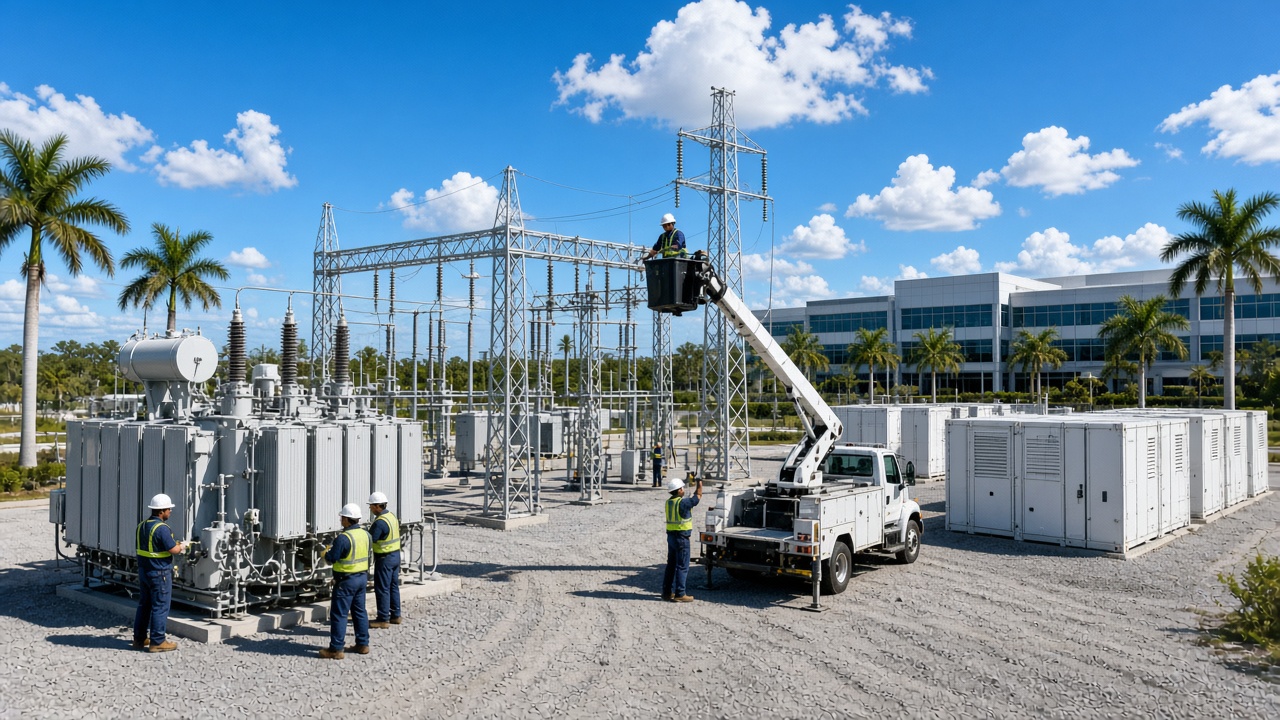
Five-year capital plans turn into real substations, transformers and battery yards, and real crews to build them.
Emera: $21.5 billion, mostly in Florida
Halifax-based Emera, owner of Tampa Electric and Nova Scotia Power, introduced a five-year, $21.5 billion capital plan on November 6. About 82% of it is aimed at Florida, for system strengthening, storm hardening and customer growth, and roughly half the plan goes to strengthening electric transmission, distribution and gas infrastructure. Emera also filed a large-load tariff in Florida, specifically to support what it calls "strong data center growth momentum."
If you're an electrician or lineworker in the Tampa Bay area, that's a very clear signal about where the steady work will be.
Southern Company: creeping toward $100 billion
Southern Company added about $4 billion to the $81 billion base capital plan it set out in February, and executives said the five-year total could rise to $100 billion as generation contracts in Alabama and Georgia are awarded.
The demand numbers behind it are striking. Southern says its portfolio of signed large-load contracts has grown to 21 GW, with another 7 GW in late stages across Alabama, Georgia and Mississippi, and data center electricity usage was 59% higher in the third quarter than a year earlier. Importantly for anyone worried about a "data center bubble," it isn't only data centers: CEO Chris Womack also pointed to projects from Airbus, Mitsubishi Power and Audi, including Mitsubishi Power's plan to greatly expand its gas turbine factory in Savannah.
Entergy and Xcel round out the picture
Entergy, which hit a system record peak of 24,000 MW in August, added roughly $1.5 billion to its 2026–2030 capital plan, including about $600 million tied to Google's expansion in Arkansas, mostly for two battery projects. It also completed the 1.2 GW Orange County Advanced Power Station in Texas.
And just before the start of the month, Xcel Energy rolled out a $70 billion five-year plan, up 17%, with 9.2 GW of new renewables, 2.3 GW of storage, 3.3 GW of gas generation and 2,400 miles of new transmission.
What I think this means for electrical careers
Add up Duke, Southern and Xcel alone and you're looking at more than a quarter of a trillion dollars in planned utility investment over five years, before you even count AEP, Entergy, Fortis and Emera. Here's how I read it.
1. This is multi-year, regulated work, not a sugar rush. Utility capital plans are filed, scrutinized by regulators and largely funded by regulated returns. They can shift, and individual projects do get delayed or denied, but this is about as durable a demand signal as construction ever gets. If you've been waiting for a sign that it's safe to commit to a utility-side career, this is it.
2. Transmission and substations are the bottleneck, so that's where the premium is. Fortis' growth is mostly transmission. Xcel is planning 2,400 miles of new lines. Emera is pouring money into T&D. Every new line needs substations at both ends, and every substation needs construction electricians, relay technicians, testing and commissioning techs and cable splicers. If you can work in a switchyard safely and competently, you'll be in demand for the rest of this decade.
3. Batteries keep popping up in every plan. Xcel's 2.3 GW, Entergy's Google-linked batteries, Fortis' mention of battery storage in Arizona. Battery energy storage is now a standard line item, which is great news for electricians who've picked up medium-voltage, DC and commissioning experience.
4. Contractors are consolidating to keep up. We're seeing private capital move into specialist electrical firms. Onni-Rye Holdings acquired Pacific Industrial Electric, a Brea, California contractor founded in 1971 that does high- and medium-voltage, power plant and data center work, on November 2. Days later, Iowa's Vision Specialty Contracting secured a growth investment from Haven Capital Partners to expand its electrical, underground utility and generator work across agricultural facilities. More capital behind contractors usually means more hiring, more training budgets and more room to move up.
5. Don't forget the people who run the grid. All this new generation, storage and transmission has to be operated, 24/7, by certified system operators in control rooms. It's one of the least-known careers in our industry, and I've written a full guide to it today: What Does a Power System Operator Do?
My practical advice this month
- Follow your local utility's plan. Search "[your utility] capital plan" or read the investor presentation. The projects listed there (new substations, rebuilt lines, storm hardening) are the jobs you'll be bidding on, or working on, in 2027 and 2028.
- Get substation-ready. NFPA 70E, switching and tagging procedures, medium-voltage terminations and basic testing skills are all worth more than ever.
- Look at the contractors winning utility work in your region, not just the utility itself. A lot of this money flows through alliance partners and specialty contractors.
- Consider moving toward the growth. Florida, the Southeast, the Carolinas, Texas, the Upper Midwest and Arizona all came up again and again in these plans.
I'll be honest: I find this genuinely exciting. A decade ago, flat electricity demand was the norm and utilities were talking about managing decline. Now they're competing to build. The grid is being rebuilt and expanded in real time, and the people who wire it are going to have a fantastic run. If you're ready for your next move, browse the latest electrical jobs across the USA and Canada and get yourself in position.