What Does a Relay Technician Do? Pay, Training and Outlook

Relay and P&C technicians keep the grid safe. Duties, a day in the life, BLS and Job Bank pay, NETA and apprenticeship paths, and how to break in.
When people picture the grid, they picture lineworkers up a pole in a storm. Fair enough. But there's a quieter role that decides whether a fault on a 765-kV line clears in a few cycles or turns into a regional blackout, and most people outside the industry have never heard of it. Meet the relay technician, also called a protection and control (P&C) technician or, in some shops, a relay and substation tech.
I'll be honest: I think this is one of the most underrated careers in the electrical world right now. It pays like a senior trade, it rewards brains as much as brawn, and the grid build-out I wrote about in our AEP transmission piece can't be energized without these people. Here's what the job really involves, what it pays in the USA and Canada, and how to get in.
What a relay technician actually does
Protective relays are the brains of the power system. They watch current, voltage and frequency on lines, transformers, buses and generators, and when something goes wrong (a tree contact, a lightning strike, a failed insulator) they tell the right circuit breakers to open, fast, so the fault is isolated and the rest of the grid keeps running. A relay technician makes sure every one of those relays, and the wiring, CTs, PTs, breakers and communications around them, will do exactly the right thing at exactly the right moment.
The US Bureau of Labor Statistics puts this work in the occupation "electrical and electronics repairers, powerhouse, substation, and relay," which it describes as people who inspect, test, repair or maintain electrical equipment in generating stations, substations and in-service relays. In practice, the core duties look like this:
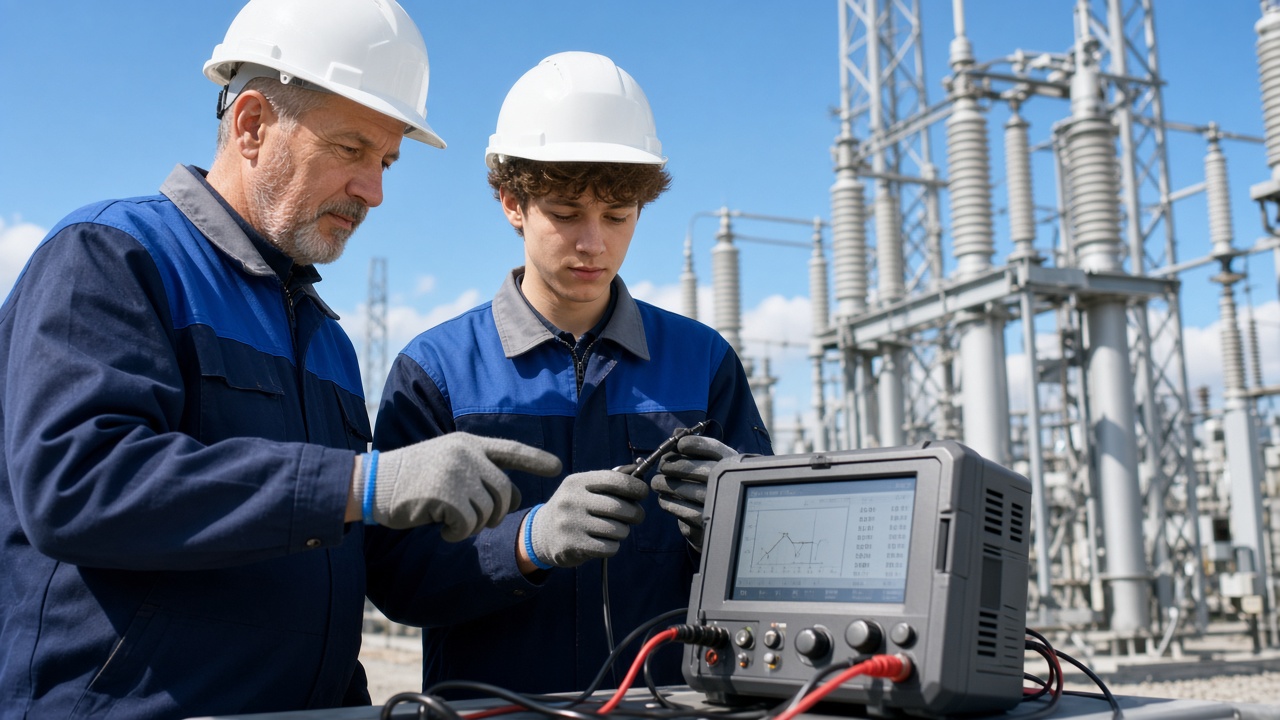
- Testing and calibrating relays with secondary injection test sets, checking pickup, timing and logic against the engineer's settings.
- Commissioning new substations and line terminals: point-to-point wiring checks, CT polarity and ratio tests, trip checks, end-to-end testing with the relay at the far end of the line.
- Routine maintenance on a schedule. Transmission owners, generator owners and distribution providers in North America have to maintain the protection systems on the bulk electric system under the NERC PRC-005 reliability standard, so documented, repeatable testing is a huge part of the job.
- Troubleshooting misoperations: pulling event records and oscillography from microprocessor relays after a fault to work out why something tripped (or didn't).
- Working with SCADA, communications and settings files, increasingly over Ethernet networks in digital substations.
A day in the life
A typical day might start in a control house at 7 a.m. with a tailboard briefing, switching orders and a clearance on the equipment you're testing. You isolate the trip circuits, hook up your test set, load the settings file on your laptop and run the test plan. Midday you might be on the phone with a protection engineer because a timer isn't matching the settings sheet, or with the system operator coordinating an end-to-end test with a crew 80 miles away. Afternoons often mean restoring the scheme, double-checking every test switch and filling out the documentation that proves the job was done right.
It's a mix of field and desk, hands and head. You'll spend time in substations in heat and cold, but you'll also spend plenty of time reading schematics and logic diagrams. Storm events and outages can mean call-outs. And when a new substation is being commissioned for a big load, the schedule can get intense, because nothing energizes until protection signs off.
What relay technicians earn
Here's the good news. In the BLS May 2025 data for powerhouse, substation and relay repairers, the national median wage was $103,020 a year, or $49.53 an hour. The bottom 10% earned $65,730 or less and the top 10% earned $129,920 or more. The mean annual wage was $100,760, across about 20,720 workers. For comparison, the median for electrical power-line installers and repairers was $95,320, so relay and substation work sits at the top of the outside trades.
Where do these people work? Mostly at utilities. BLS counts about 12,920 of them in electric power generation, transmission and distribution, followed by local government (think municipal utilities and public power) at 3,100, utility system construction at 980 and engineering services at 550. The states with the most jobs were New York, Texas, California, Ohio and Pennsylvania.
In Canada, the closest match is the "power system electrician" occupation (NOC 72202). Job Bank reports a national median of C$46.55 an hour, ranging from C$36.26 to C$60.00, with medians of C$51.64 in Alberta, C$50.99 in British Columbia and C$50.85 in Ontario.
How to train for it in the USA
There's no single front door, which is part of why so few people know about it. The main routes I see are:
Utility apprenticeships and in-house programs. Many utilities run their own relay, substation or electrician apprenticeships, often hiring from their substation crews or from people with an electrical degree. These are competitive but they're the classic path: you learn on the company's own equipment and standards.
IBEW/NECA outside apprenticeships. The joint outside line programs include a Substation Technician classification. Under the Area-Wide Outside Line Apprenticeship and Training Standards, the substation technician apprenticeship (mapped to SOC 49-2095) requires 7,000 hours of on-the-job training, including 1,500 hours of wiring and terminating control and communication cable, plus at least 144 hours a year of related instruction over three years. Substation construction is a natural stepping stone into testing and commissioning.
Testing companies and NETA certification. Independent electrical testing firms hire a lot of relay and power-systems techs, and many follow the ANSI/NETA ETT certification ladder. Level 1 is a trainee who works under supervision. Level 2 (Certified Assistant) needs 40 hours of safety training, 160 hours of electrical training and two years of related experience, plus a proctored exam. Level 3 (Certified Technician) needs 64 hours of safety, 400 hours of electrical and five years of experience, and Level 4 (Senior) needs 104 hours of safety, 600 hours of electrical and ten years. NETA notes that two or more years of electrical technical education can count for up to one year of experience, and certified techs are employed by a NETA Accredited Company.
Two-year electrical or electronics technology degrees. An associate degree in electrical, electronics or power systems technology is a common starting point for people who want to go straight into testing work, because the job is heavy on theory, schematics and test equipment.
How to train for it in Canada
In Canada, protection and control work often sits inside the power system electrician trade. In Alberta, Power System Electrician is a designated trade with a four-period apprenticeship, each period designed to take about a year: 1,590 work hours plus seven weeks of classroom in periods one and two, and 1,560 hours plus eight weeks in periods three and four, taught at NAIT and Lethbridge Polytechnic. Alberta describes the trade as working in generation, substation equipment, protection and control, and metering. Experienced workers without the ticket may qualify through the Trades Qualifier route with 72 months and 9,450 hours of verifiable experience plus an exam.
Other provinces handle it differently, and utilities run their own training programs, so check with your provincial apprenticeship authority and the big utility in your area. The Red Seal electrical trades (Construction Electrician and Industrial Electrician) can also be a good base before moving into P&C. On the outlook side, Job Bank rates prospects for power system electricians as Good in Ontario and Moderate in Alberta, Saskatchewan, Manitoba and Nova Scotia for the next three years.
Why demand is rising
BLS's newest projections show employment in this occupation growing from about 20,900 in 2025 to 22,900 by 2035, a 9.7% increase, and 12.9% inside electric power generation, transmission and distribution. That's solid for a small, specialized trade, and I think it understates the pressure.
Look at the projects. AEP plans a $37 billion transmission program and to nearly triple its 765-kV mileage by 2031, with three new 765-kV lines for a single data center campus in Ohio. Every new line terminal, every new substation and every reconductored corridor needs protection schemes designed, set, tested and commissioned. Advanced grid tech adds even more: Entergy's dynamic line rating project across 1,125 miles includes substation and terminal upgrades. In Canada, Hydro One's proposed 2028–2032 plan includes modernizing about 1,400 km of transmission lines. And the wider trade is already short: three-quarters of electrical contractors in ENR's 2026 Top 600 survey said they were short of craftworkers.
The other thing I like about this role is that it's future-proof in the right way. Relays have gone from electromechanical to microprocessor-based to networked, and digital substations are making the job more about data and communications every year. AI tools may help engineers sift event records faster, but someone still has to stand in the control house, isolate the trip circuit and prove the scheme works. That's you.
How to break in: my practical advice
- Nail the fundamentals. Three-phase power, per-unit, symmetrical components, CT and PT behavior, and reading AC/DC schematics. If you understand why a relay trips, the test sets become easy.
- Pick your door. Want stability and a pension? Target utility apprenticeships and substation roles. Want variety and travel? Testing firms on the NETA ladder. Already an electrician or lineworker? Ask about substation construction and commissioning crews.
- Get hands-on with test equipment and relay software. Some relay manufacturers and test-set makers offer training courses and configuration software you can practice with. Use what's available, and learn more than one platform so you're useful on any job.
- Learn the networking side. Basic Ethernet, fiber and substation communications knowledge sets candidates apart.
- Document everything. Clean, accurate test records are part of the craft, and employers notice.
- Look where the build-out is. Ohio, Texas, the Mid-Atlantic, Ontario and Alberta are all busy. Browse current substation, testing and P&C openings on our jobs board and set your sights on the projects that will energize in 2027 and beyond.
If you're an electrician who loves the "why" behind a fault as much as the fix, this might be the best-kept secret in the trade. The grid is getting bigger and smarter every year, and it needs people who can keep it safe. I'd love to see more of you in those control houses.