800 Volts DC, Nuclear Uprates and the New AI Power Stack
A $5B nuclear uprate loan, 800 VDC data halls, a $4.5B generator backlog and Canada's grid supply chain: what this week's power news means for electricians.
If you only read one headline about AI and electricity, it's usually "data centers need more power." True, but it hides the far more interesting story. Over the past two weeks, the news out of the US and Canada showed that every layer of the power stack is being re-engineered at once: how power is generated, how it's contracted, how it's backed up, how it's delivered inside the building, and how millions of small devices at the grid edge get coordinated.
I find that genuinely exciting, because every one of those layers lands on an electrician's to-do list eventually. Here's what happened, what I think it means, and what I'd be doing about it if I were holding a license (or thinking about getting one) right now.
Squeezing more out of the reactors we already have
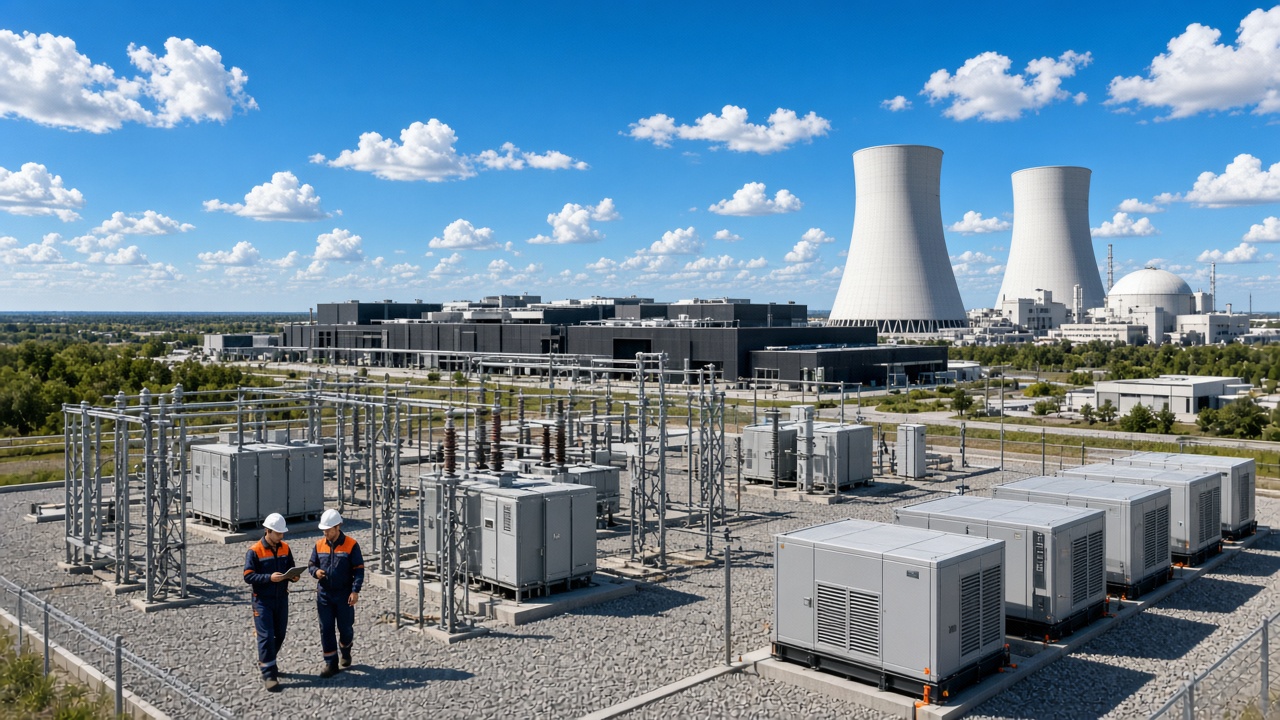
On October 27, the Department of Energy's Office of Energy Dominance Financing (the former Loan Programs Office) announced a conditional loan commitment of up to $5 billion to Constellation Energy to finance nuclear uprates and modernization across its fleet. The work spans Braidwood, Byron, Clinton, Dresden, LaSalle and Quad Cities in Illinois, Calvert Cliffs in Maryland, and Limerick in Pennsylvania, and DOE says it will add nearly 1.1 GW and support more than 10,000 project-related jobs.
The realism check: this is a conditional commitment. Constellation still has to meet technical, legal, environmental and financial conditions before the money flows. And as TechCrunch pointed out, most or all of the extra output from seven of those plants has already been bought by Google, Meta or Amazon, so don't expect it to show up as a discount on your home power bill.
Why I like it anyway: an uprate is the fastest kind of new baseload you can build, because the site, the transmission connection and the workforce already exist. What changes is the equipment. Uprates typically mean upgraded turbines, generators, transformers, switchyard gear and instrumentation and controls, all of which have to be installed, tested and commissioned during tightly scheduled outages. If you're an industrial electrician or an I&C tech who likes high-stakes, highly procedural work, nuclear outage season is about to get a lot busier.
Hyperscalers are paying for their own power plants
The second big pattern is who pays. On October 16, NiSource announced a 20-year agreement with Microsoft to serve Microsoft's data center campus in northwest Indiana. Service is expected to start in 2028, NiSource's generation company will add roughly 1,100 MW of new generation resources, and Microsoft is funding the generation and transmission needed to serve its load. NiSource's GenCo has also contracted 600 MW of battery storage under a long-term tolling agreement.
Down in Texas, Utility Dive reported on October 27 that CenterPoint Energy has lifted its 10-year capital plan by $4 billion to $70.7 billion, expects about 14 GW of new demand online through 2030, and has submitted 17 GW of projects to ERCOT's new large-load interconnection process.
I keep coming back to this "the big customer pays" model because it's what makes a build-out durable. When ordinary ratepayers aren't stuck with the bill, projects survive the politics, and that means multi-year pipelines of substation, transmission and distribution work rather than boom-and-bust. A $70 billion utility capital plan is, in plain English, a decade of steady work for lineworkers, substation electricians and relay techs in the Houston region.
The backup power queue is now measured in years
Every serious data center has a wall of standby generators behind it, and that market just told us how hot it is. In its third-quarter results on October 28, Generac said its backlog for products sold to the data center market has grown to about $4.5 billion. That includes a long-term supply agreement with Amazon whose initial deliveries total a combined $2.4 billion in 2027 and 2028. Generac's commercial and industrial sales rose about 28% to $553 million in the quarter.
Think about what that means on site. Every one of those units needs paralleling switchgear, automatic transfer switches, feeders, controls and load-bank testing before a data center can be handed over. Generator and switchgear commissioning is a specialized, well-paid niche, and with deliveries stacked into 2027 and 2028, the demand for people who can do it properly isn't going away soon.
Inside the building: 800 volts DC is coming
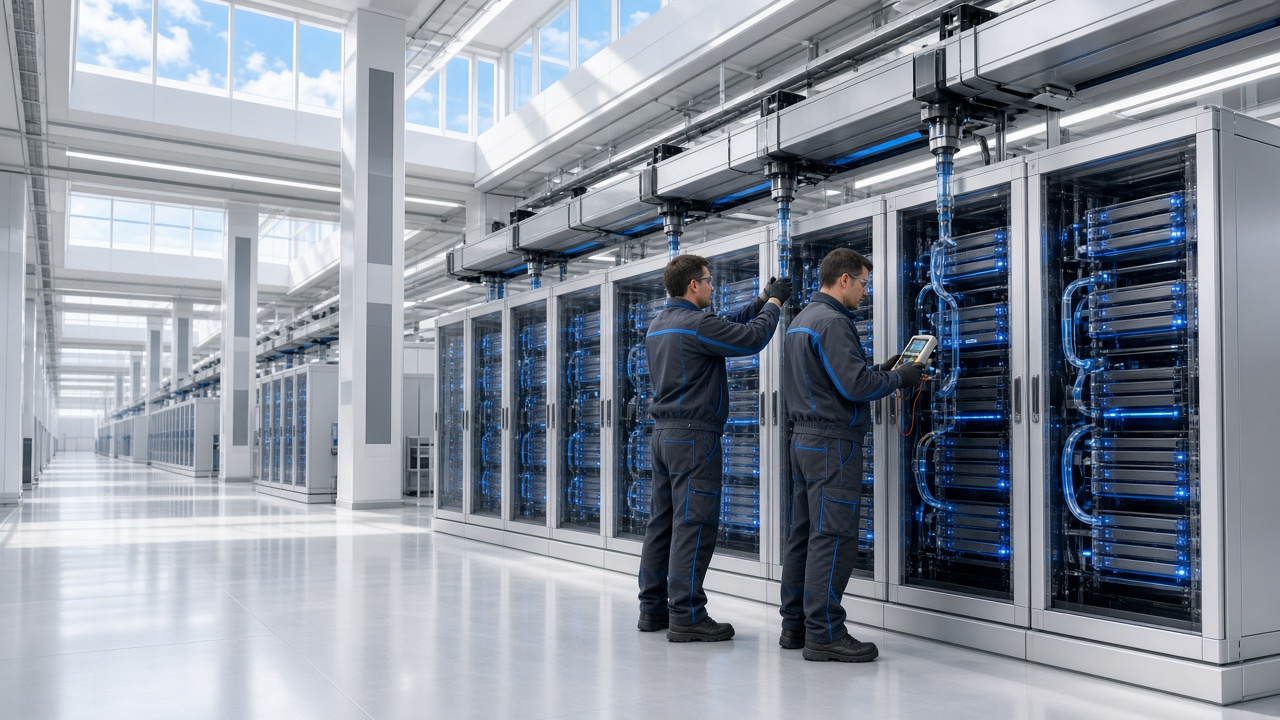
This is the one I'd tell every data center electrician to pay attention to. AI racks are getting so power-hungry that the industry is moving toward 800 VDC distribution.
Electrical Contractor magazine reported on October 26 on a new Schneider Electric white paper examining whether existing arc flash methods hold up for 800 VDC systems. Schneider's Manav Patel put the scale in perspective: five years ago, a standard hyperscale rack was around 15 kW and 70 kW counted as high density, while "A.I. training racks now draw hundreds of kilowatts, and NVIDIA's public roadmap takes them past 400 kW with a clear path to 1 MW." He expects 800 VDC to become "potentially (the) predominant architecture" for ultra-high-density AI clusters, tracking next-generation racks the industry expects in 2027-28.
A day later, Enphase said its solid-state transformer prototype had converted 13.8 kV AC to a stable 800 VDC in its Austin lab, using 132 power modules, 44 in series on each phase. According to The Data Center Engineer's write-up, Enphase plans to extend the demo to 34.5 kV, show megawatt-scale racks before the end of 2026, and run customer pilots in 2027. A prototype isn't a product, but it shows where the hardware is heading: fewer conversion stages, and medium voltage going straight to DC.
Here's the part that matters for the people doing the work. DC doesn't behave like AC in a fault. As Patel put it, "There is no zero crossing to help extinguish the arc," and the energy stored in capacitors and batteries shapes the first milliseconds of a fault. His most important line for contractors is this one: "installations will begin before every question is addressed in a prescriptive code requirement." He recommends engineered designs, documented operating sequences, manufacturer instructions, early engagement with the AHJ, and bringing contractors and electricians into design reviews early.
My read: in the next two years, the electricians who understand DC protection, stored energy, DC-rated meters and DC lockout/tagout will be the ones running the most advanced jobs in the country. There's no single "800 VDC certification" yet, so building that knowledge now, on top of solid NFPA 70E training, is a real head start.
At the grid edge: California wants your batteries to work together
On October 29, the California Public Utilities Commission directed PG&E, Southern California Edison and SDG&E to propose a common framework for orchestrating distributed energy resources such as home batteries and EVs, using visibility, forecasting and scheduling tools to call on them where and when the distribution grid needs help. The utilities will also add load-flexibility scenarios to their distribution planning starting with the 2028-2029 cycle.
That sounds like a policy story, but it's a field story too. Orchestration only works if the batteries, inverters, chargers and meters are installed, configured and communicating correctly. Residential and commercial electricians who understand controls, networking and commissioning, not just pulling wire, will be the ones utilities and installers lean on.
Canada is building the supply chain behind the grid
North of the border, two announcements caught my eye because they target bottlenecks rather than ribbon cuttings.
On October 16, the federal government committed $30 million to Hitachi Energy Canada for a $478.8 million project in London, Ontario, to build Canada's first electrical-grade pressboard plant, turning wood fibre into up to 20,000 tonnes a year of insulation materials for high-voltage transformers. Transformers have been one of the tightest constraints on grid projects across North America, so more domestic supply is good news for every substation schedule.
On October 13, Ottawa announced almost $270 million for New Brunswick, including $50 million toward a STATCOM at NB Power's Salisbury Terminal to strengthen southern New Brunswick's grid, and a $219 million Canada Infrastructure Bank loan for planning work on the Mactaquac hydro station's life extension.
And on October 27, Ontario proposed reforms for its local distribution utilities, including a requirement for 10-year plans covering condition assessments, financing and workforce strategies. The province says it will need to add the equivalent of one City of Toronto to the grid every six years. When a government starts writing workforce planning into utility rules, you know skilled people are the scarce resource.
What I'd do right now
I'm optimistic about all of this, but I'm not naive. Conditional loans can stall, prototypes can slip, and data center plans change. The good news is that the skills these stories point to are portable. Here's my practical advice:
- Get DC-literate. Between 800 VDC data halls, battery storage and solar, DC is no longer a niche. Learn DC fault behavior, stored-energy hazards and DC-rated test equipment, and make sure your NFPA 70E training is current.
- Chase commissioning experience. Generators, switchgear, UPS, batteries and DER controls all have to be proven before handover. Commissioning skills are where schedules get squeezed and where pay premiums show up.
- Look at outage and plant work. Nuclear uprates and plant modernization reward electricians and I&C techs who are comfortable with rigorous procedures and documentation.
- Learn controls and communications. California's DER orchestration push is a preview of where the grid edge is going everywhere: connected devices that have to be set up correctly to be useful.
- Follow the capital plans. Houston, northwest Indiana, Illinois, Ontario and New Brunswick all have multi-year money attached. Mobility pays early in a career.
If you want the bigger picture, catch up on how data centers drove an $80 billion year for US electrical contractors, the speed-to-power race rewiring North America's grid, and where the 2026 NEC is being enforced.
The exponential age runs on electricity, and electricity runs on skilled people. If you're ready to put your skills where the growth is, browse the latest electrical jobs across the US and Canada on ElectricalRoles.com.