

What Does an Electrical Apprentice Do? Pay, Path & How to Start

What electrical apprentices do, real pay scales, how long it takes, and the new US and Canadian incentives making November 2026 a great time to start.
If you've ever wondered where every great electrician, foreman, superintendent and electrical contractor actually starts, the answer is almost always the same: as an apprentice. And right now, honestly, I can't think of a better moment in the last few decades to be one.
We've covered a lot of roles in this series, from data center electricians to testing and commissioning techs and electrical foremen. Every one of those careers runs through the same front door. So this one is about that door: what an electrical apprentice really does day to day, what the pay looks like, how to get in, and why the money and momentum around apprenticeships this month are genuinely good news.
What an electrical apprentice actually does
An electrical apprentice is a paid trainee who learns the trade on real jobsites under the supervision of licensed journey-level electricians, while also completing classroom instruction. You're not a student who occasionally visits a site. You're on the crew, on the payroll, from day one.
In the first year, expect the work to be very hands-on and fairly basic:
- Pulling wire and cable, and learning why the right conductor in the right raceway matters
- Bending and installing conduit (the first time you nail a perfect offset is weirdly satisfying)
- Mounting boxes, devices, fixtures and supports
- Keeping material staged, tools organized and work areas clean and safe
- Reading drawings alongside your journeyman and learning how a set of plans turns into a building
By the middle years you'll be terminating, wiring panels, helping with troubleshooting, and working through the National Electrical Code with real installs in front of you. By the final year, good apprentices are running small pieces of work themselves, with a journeyman checking in rather than standing over them.
The classroom side covers electrical theory, math, blueprint reading, code, and safety and first aid. The Bureau of Labor Statistics notes that some programs also add specialized training in areas like fire alarm systems, communications and soldering. Increasingly, that classroom time also includes things like solar, battery storage, EV charging and controls, because that's where the work is heading.
How long it takes
Most electrical apprenticeships run four or five years. According to BLS, apprentices typically log around 2,000 hours of paid on-the-job training per year, plus technical instruction. Many states require about 8,000 hours of on-the-job experience before you can sit the journeyman exam. Texas is a good example: the Austin Electrical Training Alliance runs a four-year schedule built around the 8,000 hours needed to test for a Texas journeyman license.
If you already have relevant experience from the military or construction, BLS notes you may qualify for a shortened apprenticeship based on that experience and testing. In Colorado, the Independent Electrical Contractors Rocky Mountain chapter offers a Fast Track for apprentices with more than 6,000 on-the-job hours, letting them finish the 288 classroom hours the state requires in half the time. Registration for its next semester opens November 23, with classes starting the week of January 4, 2027.
What electrical apprentices get paid
This is the part people love: you earn while you learn, and your pay climbs as your skills do.
Most programs pay apprentices a percentage of the journeyman rate, stepping up every six months or year. The published scale from the Austin Electrical Training Alliance is a really clear real-world example:
- Periods 1–2: 55% of journeyman scale, $21.18 an hour (about $44,000 a year at 40 hours a week)
- Period 3: 60%, $23.10 an hour
- Period 4: 65%, $25.03 an hour
- Period 5: 70%, $26.95 an hour
- Period 6: 75%, $28.88 an hour
- Journeyman: 100%, $38.50 an hour (about $80,000 a year at 40 hours)
Rates vary a lot by region and by program, and that table is base pay before overtime, which is common in this trade. But the shape is typical: a starting rate around half of journeyman scale, with steady raises as you progress.
And the destination is solid. BLS puts the median electrician wage at $63,190 a year ($30.38 an hour) as of May 2025, with the top 10% earning more than $108,510. Electricians in manufacturing had a median of $74,550, and those in government $79,820. Then there's the real upside: foreman, superintendent, estimator, project manager or your own contracting business.
The part I always stress to people weighing college against the trades: apprentices generally aren't racking up tuition debt while they train. You're being paid to build a career rather than paying for the privilege.
Union, non-union, or employer-run
There are three main routes in the US, and all of them can lead to a great career:
- Joint (union) programs. Run by IBEW locals and NECA contractors through local Joint Apprenticeship Training Committees, often branded as Electrical Training Alliances. Competitive entry, structured pay scales, strong benefits.
- Merit shop programs. Run by groups like Independent Electrical Contractors (IEC) and Associated Builders and Contractors (ABC) chapters. Typically you're hired by a member contractor and attend classes in the evening or in blocks.
- Employer programs. Some contractors and industrial employers run their own registered or unregistered training. Check whether a program is a Department of Labor or state-registered apprenticeship, because that affects licensing credit and portability.
My honest advice: don't overthink union vs. non-union at the start. Look at the local options, ask about pay progression, what kind of work the contractors do (residential, commercial, industrial, data center), and how many apprentices complete. Then apply to more than one.
Why this is a great month to start
There's real momentum behind apprenticeships right now, and it's coming from government and industry at the same time.
The Labor Department is paying sponsors to grow. On November 2, the Department of Labor opened applications for its Pay-for-Performance Incentive Payments Program. As the Hard Hat Report laid out, one fund run by Jobs for the Future puts $40 million toward apprenticeships tied to data centers, semiconductor fabs and nuclear energy infrastructure, and electricians are on the eligible list. It pays sponsors $3,750 once an apprentice stays 90 days and $2,250 at completion or 12 months, so up to $6,000 per new apprentice. There's a catch: established programs have to clear a growth threshold before new hires qualify. But the signal is clear. Contractors are being rewarded for taking on and keeping new people. That's good news if you're trying to get hired.
High schools are getting in earlier. In Ohio, IBEW Local 540 and the Canton Electrical JATC launched a pre-apprenticeship program that lets 116 high school juniors and seniors across 11 Stark County districts earn their first year of apprenticeship training while still finishing school. I love this model. Teenagers walking out of high school a year into a skilled trade, with no debt, is exactly the kind of practical thinking we need more of.
Canada is sweetening the deal too. North of the border, registered apprentices in Red Seal trades (electrician included) can access the Canada Apprentice Loan, up to $4,000 per technical training period, with no interest and no payments while you're registered. And as we covered recently, Canada's $5,000 Red Seal Completion Bonus opens for applications on November 16, rewarding new journeypersons for finishing. On the employer side, Ottawa's new Powering Canada Strong action plan says the Build Canada Apprenticeship Service will launch this fall, offering small and medium-sized employers up to $10,000 to hire first-year apprentices in Red Seal trades. More incentive for employers means more first-year seats for you.
And the demand isn't going anywhere. BLS projects electrician employment to grow 9% from 2025 to 2035, much faster than average, with about 72,700 openings a year. It specifically points to AI, data centers and grid upgrades as drivers. We've written about how electricians became the hardest hire of 2026, and that pressure is exactly what makes contractors keen to train people.
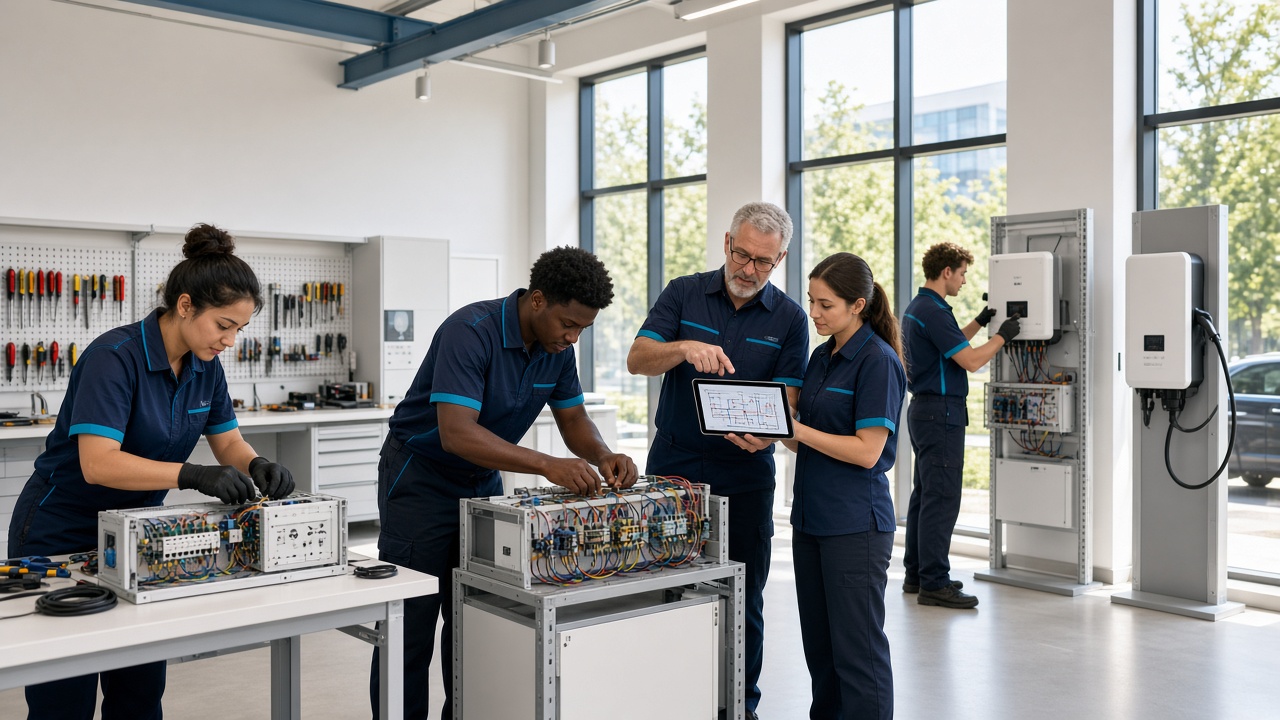
Today's apprentices train on solar inverters and EV chargers as well as conduit and panels, so the skills you learn early travel a long way.
Where an apprenticeship can take you
This is the bit I find most exciting. A first-year apprentice in 2026 is walking into a trade that's being reshaped by:
- AI data centers that need enormous amounts of power distribution, switchgear, UPS systems and commissioning
- Solar, battery storage and EV charging, which keep setting records
- Grid modernization, from substations to undergrounding
- Smart buildings and controls, where electrical work meets software
Spend a few years becoming a really good journeyman, then pick your lane. Some people love the field and become foremen and superintendents. Others move into estimating, project management, inspection or testing. Plenty start their own shops. The leadership side is getting serious investment too: NECA and ELECTRI International just announced a $4 million investment from Google to expand their Project Management Apprenticeship and leadership training, with the first expanded cohorts due in the second quarter of 2027.
How to get started: my practical checklist
- Get your basics in order. A high school diploma or GED, a driver's license, and a solid grasp of algebra will help you through aptitude tests and the job itself.
- Find programs near you. Search apprenticeship.gov in the US, your local Electrical Training Alliance, and IEC or ABC chapters. In Canada, start with your provincial apprenticeship authority.
- Watch the intake windows. Many joint programs only open applications at certain times of year. Put the dates in your calendar.
- Prepare for the aptitude test. Practice algebra and reading comprehension. It's very passable with a few weeks of steady prep.
- Show up like a pro. Interviewers look for reliability, curiosity and a safety mindset. If you've done any hands-on work (construction, mechanics, even serious DIY), talk about it.
- Consider starting as a helper. If programs are full, a helper job with a good electrical contractor gets you on site, builds hours and often leads directly into an apprenticeship.
- Browse live roles. We have hundreds of electrical jobs across the USA and Canada, including apprentice and helper positions. Set up a job alert so new ones come straight to you.
The bottom line
An electrical apprenticeship is one of the few career paths where you get paid from the first day, finish with a licensed, portable skill and little or no debt, and step straight into an industry that's being supercharged by data centers, clean energy and the grid build-out. Government money and industry investment are lining up behind new apprentices right now.
If you've been on the fence, this is your nudge. Apply, show up, and learn everything you can. The electricians running the most exciting projects of the 2030s are starting their first year right now. It might as well be you.