

What Does a Testing and Commissioning Electrician Do? Pay, NETA & Outlook

Testing and commissioning electricians verify power systems before energization. Here's the NETA ladder, 2026 pay ranges, and how to break into the role.
If you have ever watched a data center or substation go live, you know the quietest people in the room are often the ones who matter most. Before the first breaker closes, someone has to prove the gear will behave. That someone is usually a testing and commissioning electrician — also called a NETA electrical testing technician, power testing tech, or acceptance-testing specialist.
This is one of the sharpest career paths in the electrical trades right now. Grid modernization, battery storage, and hyperscale data centers all need third-party testing before energization. The work pays well, the skills travel, and the demand curve looks a lot like the build-out itself: up and to the right.
What the job actually is
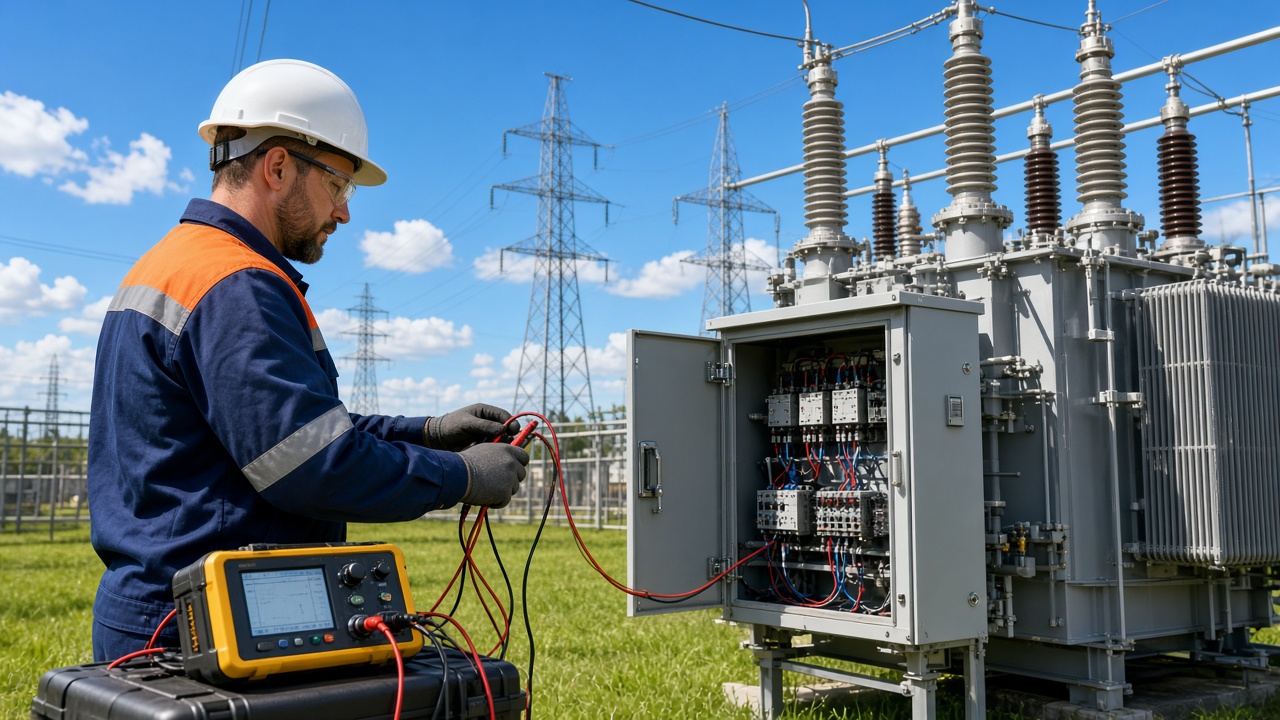
Testing and commissioning (T&C) electricians test, energize, troubleshoot, and document electrical power systems before and during startup. The kit list is the backbone of modern power distribution:
- Switchgear and motor control centers
- Transformers (dry-type and oil-filled)
- Circuit breakers and protective relays
- Grounding systems and cable installations
- Controls, interlocks, and SCADA interfaces
Day to day, you read one-lines and schematics, set up insulation resistance and contact resistance tests, run relay and breaker procedures, compare results to manufacturer data and previous baselines, and write the reports that let owners, AHJs, and insurers sleep at night. On commissioning jobs you work alongside design engineers, commissioning agents, and construction electricians to prove the whole system works together — not just that each asset passed a bench test.
That last point is the real craft. Running a procedure when everything behaves is useful. Staying with the problem when a CT circuit does not look right, a breaker operates slowly, or the drawings do not match the field is what separates a technician from a checklist follower.
The NETA ladder (and where NICET fits)
In the United States, the InterNational Electrical Testing Association (NETA) Electrical Testing Technician (ETT) certification is the common career ladder. Levels build on each other and, importantly, candidates generally need to be employed by a NETA Accredited Company:
- Level I — Trainee: supervised entry; employer-administered exam
- Level II — Certified Assistant Technician: about two years of related experience, plus safety and electrical training hours, then the NETA exam
- Level III — Certified Technician: about five years; can supervise lower-level techs, evaluate test data, perform switching, and own moderately complex jobs
- Level IV — Senior Certified Technician: about ten years; leads large projects and multiple crews, handles complex investigations, and signs off on high-stakes work
NICET Electrical Power Testing covers much of the same territory. Many employers list NETA III, NICET, or equivalent experience as interchangeable on the same posting. The credential documents progress; the field judgment behind it is what gets you hired and paid.
What the work pays in 2026
There is no official national NETA salary table — BLS does not track workers by certification level — so the honest way to talk about pay is with market ranges and real job ads.
Industry career guides for 2026 commonly put entry NETA work in the $60,000–$85,000 band, mid-level around $85,000–$110,000, and senior or lead roles at $110,000–$160,000+. Data-center and high-voltage commissioning often land higher once overtime, travel, and per diem stack up.
A useful federal benchmark is Electrical and Electronics Repairers, Powerhouse, Substation, and Relay: May 2025 BLS data put the national median near $103,020 a year. That category overlaps with testing work without being identical to it.
On the job-ad side, a 2026 analysis of NETA/NICET pay cited an ABM Industries posting for an Electrical Test Technician (NETA III or NICET preferred) at $52–$67 per hour — roughly $108,000–$139,000 at straight time before OT and travel. Senior Level III and Level IV roles commonly advertise in the mid-$60s to mid-$80s per hour when the work involves relays, outages, or mission-critical facilities. See Prime Systems Academy's 2026 salary breakdown for methodology and caveats.
The pattern is consistent: base pay is solid, and the upside sits in overtime windows, travel-heavy commissioning, and specialty skills (protective relays, medium-voltage apparatus, data-center energization).
Why demand is hot
Every major electrical build today ends with a testing and commissioning gate. Owners will not energize until someone independent says the system is ready. That creates steady third-party demand across:
- Data centers — dense power trains, UPS, generators, and switchgear that all need acceptance testing on aggressive schedules
- Substations and transmission — new bays, transformers, and protection schemes tied to grid modernization
- Battery energy storage — DC and AC coupling, inverters, and protection that still need rigorous startup documentation
- Industrial and commercial power upgrades — plants and campuses refreshing aging gear
If you have been following the transformer crunch or the NERC data-center reliability push, you already know the story: more assets, tighter schedules, higher consequences of getting energization wrong. T&C sits right in that choke point — which is why hiring managers keep asking for people who can test, interpret, and document under pressure.
How to move from journeyman into T&C
Plenty of strong T&C technicians started as construction or industrial electricians. The transition is real, but it is not automatic. Here is a practical path that works:
1. Build the theory you already half-know. Insulation resistance, dielectric, contact resistance, power factor/dissipation factor, turns ratio, relay functional tests — get comfortable with why the test exists, not just which button to press.
2. Get around power equipment. Seek jobs that put you near switchgear, transformers, and MCCs. Maintenance, industrial, or utility-side work beats pure residential for this leap.
3. Target NETA Accredited Companies (or equivalent testing firms). In the NETA system you typically progress while employed by an accredited company. Look for openings titled electrical test technician, field service technician, or commissioning electrician.
4. Stack certifications intentionally. Aim for NETA Level II early, then Level III as you take ownership of jobs. NICET Electrical Power Testing is a strong parallel or alternative path. Relay-focused training (and eventually deeper protection work) multiplies your value — related roles are covered in our relay technician guide.
5. Decide travel vs local. Many testing firms are travel-heavy: outages, plant shutdowns, and data-center go-lives rarely land on a neat 8–5 schedule. Local utility or industrial roles exist, but the highest pay and fastest skill growth often come with a suitcase. Be honest with yourself about that trade-off before you jump.
6. Learn to write. Clean reports, clear punch lists, and the ability to explain a failed result to a customer are career accelerators. The technician who can both troubleshoot and communicate gets the lead roles.
Where the roles are — and how to find them
Work clusters around major construction markets and grid build-outs: Texas, the Mid-Atlantic and Southeast data-center corridors, the Midwest industrial belt, California, and Canada's power provinces. Travel roles will take you wherever the outage window is.
If you are ready to look, browse live openings on ElectricalRoles.com/jobs — filter for testing, commissioning, NETA, substation, and data-center titles. Hiring is competitive for proven Level III talent and surprisingly open for motivated Level I/II candidates who already hold a journeyman card and can show curiosity about power systems.
The optimistic take
Electrical work has always rewarded people who go deep. Testing and commissioning is that depth applied to the most consequential moment on a project: the moment before the system goes live. Pay is strong, the ladder is clear, and the projects — data centers, substations, storage, industrial upgrades — are not slowing down.
If you like drawings, diagnostics, and the satisfaction of proving something works before anyone else touches the switch, this is a role worth building toward. The grid is getting denser and smarter. Someone has to certify that it is also safe. That someone can be you.