What Does an EV Charging Electrician Do? Pay, EVITP and Outlook
EV charging electricians build and service fast-charging hubs across the USA and Canada. Real pay data, EVITP certification, code changes and how to start.
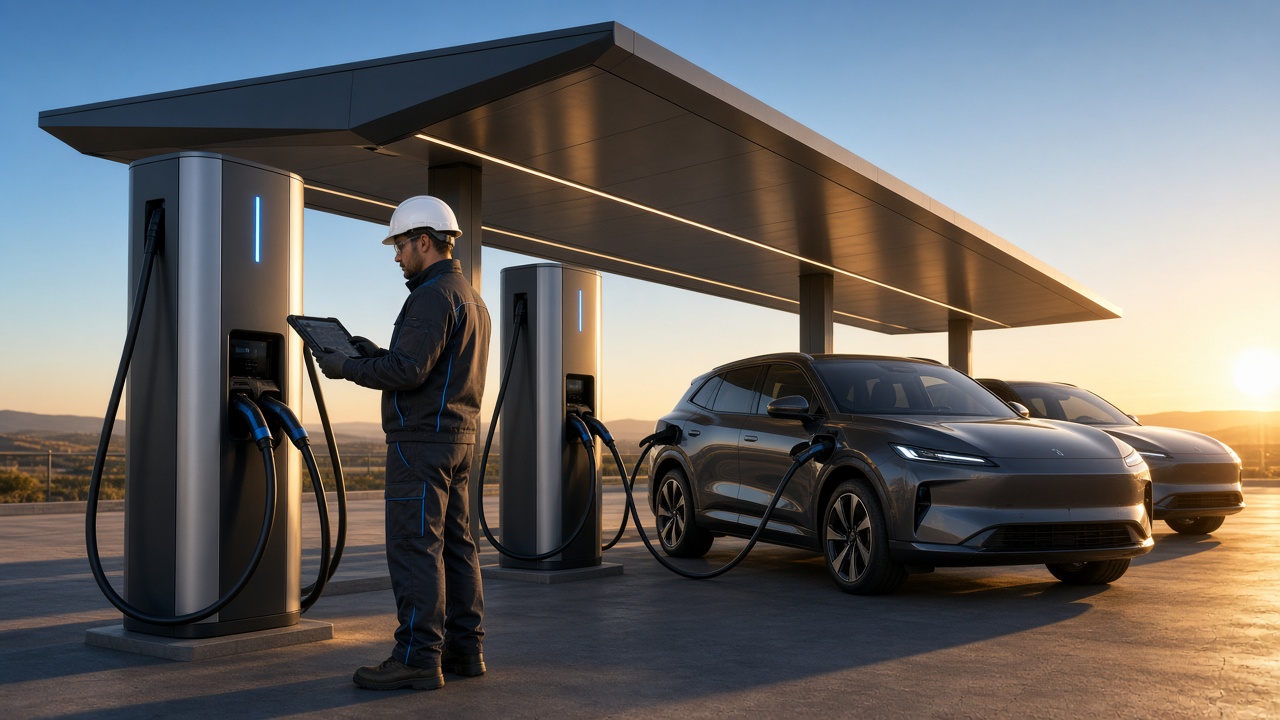
Pull into a new fast-charging hub today and you will see eight, twelve, sometimes twenty-four stalls under a canopy, each one pushing hundreds of kilowatts into a car in the time it takes to grab a coffee. Somebody had to trench the conduit, set the transformer, land the cables, terminate the dispensers, commission the site and then keep it working through a Texas summer or a Quebec winter. That somebody is an EV charging electrician, and it is one of the most interesting new specialties in the trade.
This is the latest in our Roles Explained series. If you are new to the trade, start with our overview of what an electrician does, then come back here.
What an EV charging electrician actually does
There is no separate government job title for this role. In the US it sits inside the electrician occupation, and in Canada it is mostly construction electricians (a Red Seal trade, known as 309A in Ontario) and industrial electricians doing the work. But the day-to-day is distinct enough to treat as its own specialty, and it splits into a few clear areas.
- Site assessment and load calculations. Before anything is installed, someone has to work out whether the building or utility service can carry the load. For a home, that might be a 48 A Level 2 charger on a 200 A service. For a highway hub, it is a new utility transformer, switchgear and a conversation with the power company.
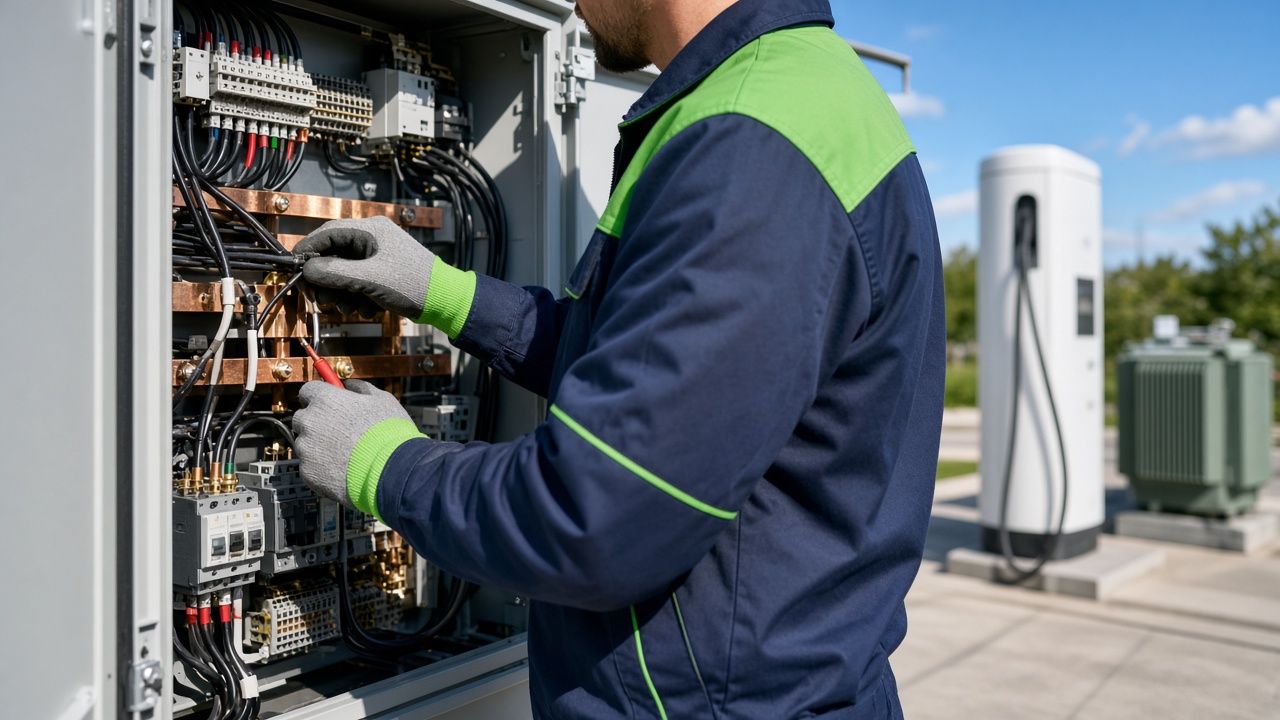
- Installation. Underground conduit, pads, feeders, panelboards, transformers, power cabinets and dispensers, plus the communications wiring that connects every charger to the network. Fast chargers often use liquid-cooled cables and high-voltage DC, so it is a long way from wiring a garage outlet.
- Commissioning. Testing, energizing, configuring the chargers and proving every port works with real vehicles before the site opens.
- Maintenance and repair. Chasing faults, swapping power modules, replacing damaged cables and connectors, and keeping uptime high. This is increasingly where the long-term jobs are.
- Load management. Setting up chargers with adjustable current limits or power control systems so they share the available capacity without overloading the service.
The Electric Vehicle Infrastructure Training Program (EVITP), the main industry certification, lists the scope well: site assessment, load calculations, the National Electrical Code, jobsite safety, personal protective equipment and installation and maintenance best practices. Its current curriculum, EVITP 5.0, covers DC fast chargers, inductive charging equipment, liquid-cooled conductors and vehicle-to-grid applications.
Why this role is growing right now
The buildout keeps getting bigger in the way that matters most to electricians: power per site.
Charging data firm Paren's Q3 2026 report, published October 13, found the US added 664 new fast-charging stations and 4,106 ports in the quarter, pushing the national network past 80,000 fast-charging ports at 14,614 stations for the first time. Openings are actually running about 20% behind 2025 by station count, but ports are down only about 9%, because each new site is bigger. New non-Tesla sites averaged 5.0 ports, up from 4.1 a year earlier, and 73% of new ports are rated at least 250 kW. Among non-Tesla networks, 35% of new ports were rated 400 kW or more, up from 10% a year ago. Charging sessions hit 50.4 million in the quarter, up 26%.
Bigger, higher-power sites mean more switchgear, more medium-voltage work and more complicated commissioning. That is skilled electrical work, and it pays accordingly.
Public money is still flowing too, despite the federal turbulence of the last couple of years. On October 28, Pennsylvania announced $37 million to build 515 new public charging ports across Bucks, Chester, Delaware, Montgomery and Philadelphia counties under the community charging phase of the federal National Electric Vehicle Infrastructure (NEVI) program. The state already has 54 NEVI-funded stations open, more than double any other state, with 34 more in planning and construction. On October 15, the Texas Department of Transportation awarded $226 million for 321 more stations, with 22 Phase I stations already open, five more due by the end of 2026 and 30 planned for 2027. And on October 19, Electrek reported that Arizona's first three NEVI stations opened in Tucson, Green Valley and Wellton, with ADOT seeking bids for 49 more locations.
Canada is growing as well, if more slowly. Paren's Canadian data, summarized by ChargerFeed, counted 2,740 fast-charging stations and 9,615 ports at the end of September, with ports up 26.8% year over year and charging sessions up 37%. Quebec accounted for nearly half of the quarter's new stations, followed by Ontario and British Columbia.
The certification that opens doors: EVITP
Here is the detail every US electrician should know. Federally funded NEVI chargers come with a workforce rule. Under 23 CFR 680.106(j), every electrician installing, operating or maintaining NEVI-funded chargers must either hold EVITP certification or have graduated from (or hold a continuing education certificate from) a registered electrical apprenticeship program that includes charger-specific training. On projects with more than one electrician, at least one must meet that requirement and at least one must be enrolled in a registered electrical apprenticeship.
That makes EVITP one of the cheapest high-value credentials in the trade. According to EVITP's FAQ:
- You must be a state-licensed or certified electrician, or, in states that do not license electricians, document at least 8,000 hours of hands-on electrical construction experience.
- The online course is 20 hours and costs $350.
- The proctored online exam requires 70% to pass.
- Certification covers all 50 states and expires after three years, with a condensed recertification option.
- EVITP is not offered online in Canada. Canadian electricians are directed to NETCO for details.
Some states go further. In California, the Energy Commission requires EVITP-certified electricians on crews for the charging projects it funds. If you want to work on public charging, getting certified is about the easiest way to move to the front of the hiring line.
The code is catching up, too
The 2026 National Electrical Code made real changes to Article 625, the EV article, and they matter in the field. A detailed breakdown from Solar Tech Collective highlights:
- 625.4 now requires permanently installed EV power transfer equipment to be installed by qualified persons.
- 625.5 requires permanent field markings showing supply voltage, phases, full-load current and short-circuit current rating.
- 625.41 treats charging equipment, including bidirectional equipment, as a continuous load for sizing feeders, branch circuits and overcurrent protection.
- 625.42 allows the supply to be sized for a limited load when a power control system or locked adjustable current settings are used.
- 625.43(D) adds an emergency shutoff requirement for sites other than one- and two-family dwellings, located 20 to 100 feet from the equipment and in sight of it.
- 625.44 says a 50 A receptacle cannot go on a 40 A EV branch circuit, and non-locking 30, 50 and 60 A receptacles used with portable chargers must be listed for EV use.
The code also now covers EV power export and bidirectional charging. Vehicle-to-home and vehicle-to-grid are moving from demos to real products, and the electricians who understand how a car can safely become a backup power source will be in demand. We covered the wider rollout of the new code in our 2026 NEC adoption update.
Pay: what to expect
Because government data does not split out EV charging work, the honest benchmark is electrician pay. The Bureau of Labor Statistics reports a median of $63,190 for US electricians in May 2025, with the top 10% above $108,510. Medians vary by industry, from $61,570 at electrical contractors to $74,550 in manufacturing and $79,820 in government, excluding state and local education and hospitals. BLS projects 9% employment growth from 2025 to 2035, with about 72,700 openings a year, and calls out grid upgrades and new power infrastructure as drivers.
In Canada, Job Bank's wage data for construction and maintenance electricians (NOC 72200) shows a national median of $35.00 an hour, ranging from $20.00 to $48.00 (2023–2024). Provincial medians include $41.30 in Quebec, $38.00 in Alberta, $37.50 in Saskatchewan and $34.00 in both Ontario and British Columbia. 87.2% of workers get at least one non-wage benefit.
My read: EV charging skills will not reinvent your pay scale overnight, but they help you get hired, keep you working when residential slows down and lead naturally into higher-paid commissioning, service lead and project roles. Fast-charging sites also have to keep running for years. NEVI rules require chargers to be maintained for at least five years from opening, which helps create steady service work.
Skills that separate the best
- Load calculations and service planning. The ability to tell a customer exactly what their service can handle, and how a power control system might avoid an upgrade, is gold.
- DC and medium-voltage confidence. Fast chargers run at up to 920 V DC under NEVI rules and are often fed from dedicated transformers. Training in high-voltage safety and NFPA 70E is non-negotiable.
- Networking and software. Every charger is a networked computer. Comfort with modems, configuration portals, firmware updates and fault logs makes you far more useful on commissioning and service calls.
- Troubleshooting. Reliability is now the industry's obsession. Paren put national reliability at 93.9 in Q3, and operators are under pressure to push it higher. Techs who find the root cause instead of swapping parts get noticed.
- Customer skills. Residential installs mean explaining options clearly to homeowners, and commercial sites mean working with property owners, utilities and inspectors.
How to get started
- Finish your apprenticeship and license first. EV work is electrical work. A solid journeyman foundation, or a Red Seal in Canada, comes first.
- Get EVITP certified as soon as you qualify if you are in the US, or ask NETCO about options in Canada.
- Learn the 2026 NEC Article 625 changes and your local amendments.
- Look beyond the installers. Charging networks, utilities, fleet operators, transit agencies and big retailers building charging all hire electricians and field technicians.
- Ask for vendor training. Many charger manufacturers offer service training. Learn more than one platform so you are not tied to a single brand.
- Use AI as a sidekick. Tools like Grok Bot, ChatGPT or Claude can help you practice load calculations or decode a fault description, but always confirm against the manual, the code and your AHJ.
The EV charging buildout has had its ups and downs, but the long-term direction is clear: bigger sites, higher power, smarter load management and cars that can send power back. That adds up to more sophisticated electrical work, and I think it is one of the most exciting places to build a career in the trade right now.
Browse the latest electrician and field technician jobs on ElectricalRoles.com and set up a job alert so the next EV charging role finds you first.