
Meta's Trades Academy, JLL's Labor Warning and Vancouver's Big Dig
Meta is paying to train electricians, JLL says the South will run shortest on trades by 2028, and Vancouver starts a $1.457B substation. Here's what it means.
Most weeks, the big electrical news is about hardware: a new line, a new battery, a new transformer plant. This week the most interesting stories were about people. Specifically, who is going to build all of this, where they're going to come from, and who is paying to train them.
A tech giant is now funding trades classrooms in Louisiana and Texas. One of the biggest names in construction consulting just published a 2027 outlook that basically says electricians in the South are about to be the scarcest people on the jobsite. Contractors keep buying each other for their crews and their capabilities. And up in Vancouver, an underground substation the size of a city block is about to start construction.
Here's the roundup, and what I think it means if you work in the trade or you're thinking about joining it.
Meta's trades academy goes local in New Orleans and Houston
Back in June, Meta announced America's Workforce Academy, an initial $115 million commitment to free skilled-trades training in Indiana, Louisiana, Ohio and Texas, built around a five-week course and a guaranteed job in a skilled trade for graduates. Five months later, it's turning into real classrooms with real names on the roster.
On November 10, the New Orleans Career Center announced Meta's investment in its tuition-free building trades program, which teaches welding, electrical, carpentry and HVAC. The center didn't disclose the local dollar amount, but the goals are concrete:
- Prepare more than 500 young people for entry-level construction jobs over the next two years
- Last training year, 98% of building trades trainees earned industry credentials
- 56 trainees have since landed construction jobs, with starting wages averaging about $24 an hour
The project pulling all of this along is Meta's Richland Parish data center, where the career center says Meta has committed more than $50 billion and about 7,500 jobs are expected at peak construction. My favorite detail: a 23-year-old graduate named Kearries Cooper spent four years working in restaurants, finished the welding program in May with three credentials, started with New Orleans contractor RNGD on June 2, and was on the Meta site within a month.
Meanwhile in Texas, ABC Greater Houston says it was picked as a pilot location for the same academy, run with Meta and CBRE and delivered by ABC's education affiliate, CMEF. The first Houston cohort started on November 2, with groups of roughly 20 people going through an intensive five-week program in electrical, mechanical, carpentry, safety, equipment operations and general construction.
My take: I love this, with one honest caveat. Five weeks doesn't make anyone an electrician. What it does is get a motivated person through the front door with a credential, a paycheck and a supervisor who can see what they're made of. From there, the real career is the apprenticeship: four or five years of supervised hours and classroom time that turns a helper into a licensed journey-level electrician. If you go through one of these academies, treat it as the on-ramp, not the destination, and start asking about your contractor's apprenticeship on week one.
The bigger signal is who's paying. When the companies buying the power start funding the people who wire it, that tells you exactly how tight they think the labor market is going to get.
JLL: the South will be shortest on electricians by 2028
That brings me to the most useful report I read this week. On November 12, JLL released its 2027 U.S. Construction Perspective, and the headline is that the South is set to lead US construction growth next year, driven by data centers, power and public civil work. It's also where the workforce is stretched thinnest.
The numbers worth knowing:
- JLL forecasts US tender prices (what contractors actually bid) will rise 3.1% to 4.2% in 2027, above the pre-2020 norm of 2% to 3%.
- By 2028, the South is expected to carry the heaviest construction workload per worker of any US region.
- On a data center, mechanical, electrical and plumbing systems make up 50% to 58% of total cost, compared with 28% to 32% on a typical commercial building.
That last stat is the one I'd underline. On a commercial office, MEP is less than a third of the job. On a data center, it's more than half. That's why electricians, mechanical contractors and pipefitters are the trades everyone is fighting over.
JLL's Jaymie Gelino put it bluntly: "The South is where the pipeline is, and it's also where the trades are hardest to find." She also pointed out that these workers "are locally credentialed and tied to specific projects, so they don't move to where the work is."
In a follow-up interview with Data Center Knowledge, JLL's Matthew Giddings added a line that every commissioning tech should frame: "We've seen situations where facilities were substantially complete with power available but remained months away from operation because qualified commissioning personnel weren't available." He also noted that developers are already paying overtime, travel, lodging and relocation premiums to bring specialists into markets that don't have enough local labor.
My take: If you hold a license in Texas, Georgia, the Carolinas, Tennessee or Louisiana, your local credential is quietly becoming one of your most valuable assets. And if you're choosing what to get good at next, the bottleneck skills are commissioning, testing and medium-voltage work. I wrote about what testing and commissioning electricians do a week ago, and this report is basically a neon sign pointing at that career.
Contractors keep buying capability
The deal flow hasn't slowed either. A couple of announcements from the past two weeks show where contractors think the work is going:
- SOLV Energy buys ASB Energy Services. On November 2, SOLV completed its acquisition of ASB, an Amarillo, Texas contractor that specializes in substation foundations, civil construction and battery storage infrastructure, for about $45 million. SOLV says the deal expands its self-perform high-voltage construction capabilities and its presence in Texas. ASB keeps its leadership team.
- Vision Specialty Contracting takes on a growth investor. On November 5, the Des Moines-based electrical, plumbing and underground utility contractor announced an investment from Haven Capital Partners. Vision serves pork, poultry, cattle and egg producers, and plans to expand into new regions and add automation and modernization work.
Add EMCOR's agreement to buy P1 Construction, which I covered yesterday, and the pattern is pretty clear. Buyers want self-perform crews, fabrication, high-voltage capability and a foothold in growth regions. I also love the Vision story because it's a reminder that not every great electrical career runs through a hyperscale campus. Agricultural facilities need serious power, backup generation and controls too, and those jobs are often close to home.
Canada: Vancouver starts building a substation underground
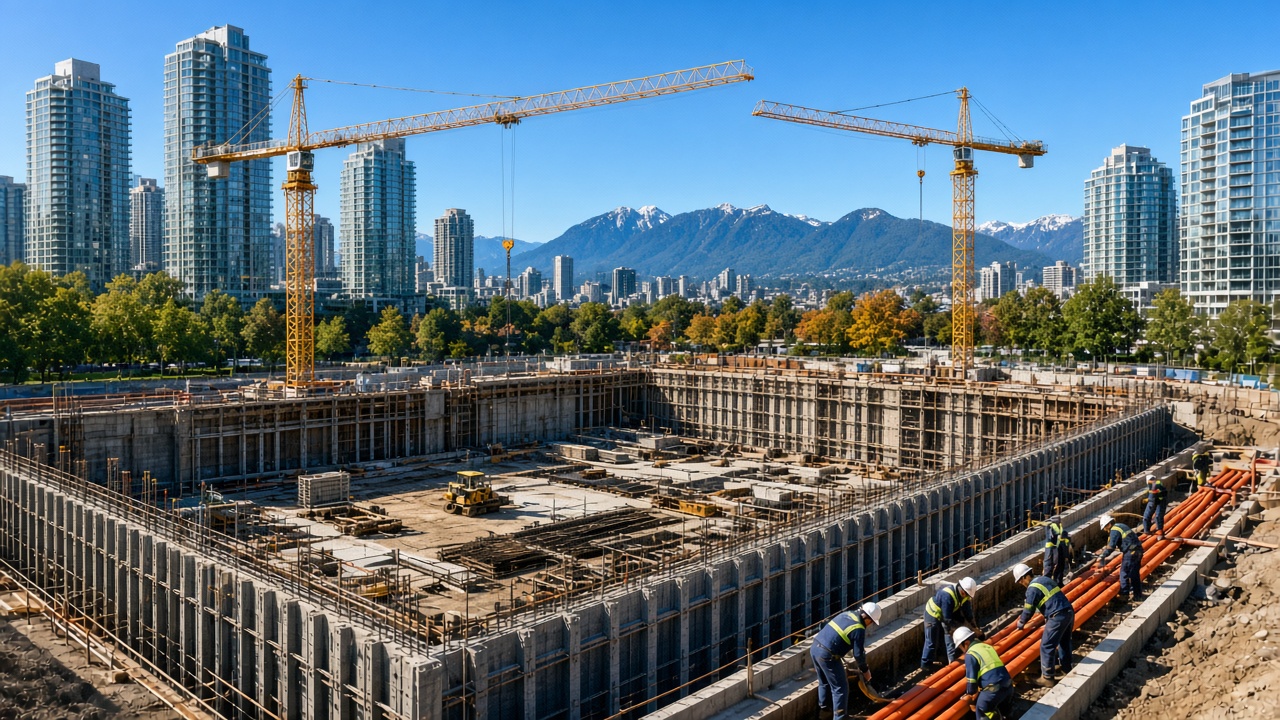
North of the border, the British Columbia Utilities Commission approved BC Hydro's West End Substation on October 29. It's an estimated C$1.457 billion project to build a brand-new underground substation at the Lord Roberts Annex site in downtown Vancouver, replacing the 74-year-old Dal Grauer station. Service is expected by 2032.
According to BC Hydro's project page, construction is expected to begin in mid-November. The utility expects about three years to excavate and build the structure up to ground level, then several more years installing substation equipment underground. New underground power lines will run through trenches in Nelson Park. The station serves about 50,000 homes and businesses, and the deal also delivers a new school and playing field for the neighborhood.
I think this is a genuinely clever bit of city building. Putting the substation underground on public land means no homes come down and the community gets new facilities on top. For electrical workers, it's a long, steady pipeline of civil, cable, substation and commissioning work in the middle of a major city.
In Ontario, the province's Apprenticeship Capital Grant call for proposals opens to approved training delivery agents on November 24 and closes December 18. The program funds training-facility upgrades and equipment, and the eligible trades list includes 309A Electrician (Construction and Maintenance) and 442A Industrial Electrician. If you run or work with a training provider, it's worth a look.
What this means for you
Here's my practical read on the week:
- If you're new or switching careers: the doors have never been wider. Free, short academies and tuition-free programs like the ones in New Orleans and Houston can get you on a site fast. Use them, then push straight into a registered apprenticeship.
- If you're an apprentice: ask to rotate through commissioning, testing or medium-voltage terminations. Those are the skills JLL says are holding up energization dates.
- If you're journey-level in the South: know your worth. Local licenses are scarce, and developers are already paying travel and relocation premiums to fill gaps.
- If you're open to travel: per diem and relocation packages are part of the market now. Ask about them directly.
- If you run a contractor: build relationships with trade schools and community colleges now, not when the project breaks ground. That's straight from JLL's playbook, and it's good advice.
I'm genuinely optimistic about all of this. The money for power and data infrastructure is real, and now the money for the people who build it is showing up too. That's how booms turn into long, stable careers.
If you're ready for your next move, browse the latest electrical jobs across the US and Canada.