What the job involves day to day
A wind tech keeps turbines running. You inspect towers, lubricate parts, test electrical, mechanical and hydraulic systems, and swap out worn components. Most of the work happens in the nacelle, the housing on top of the tower that holds the generating equipment. You also pull turbine data, and some crews service wind farm substations, underground collection lines and fiber control systems.
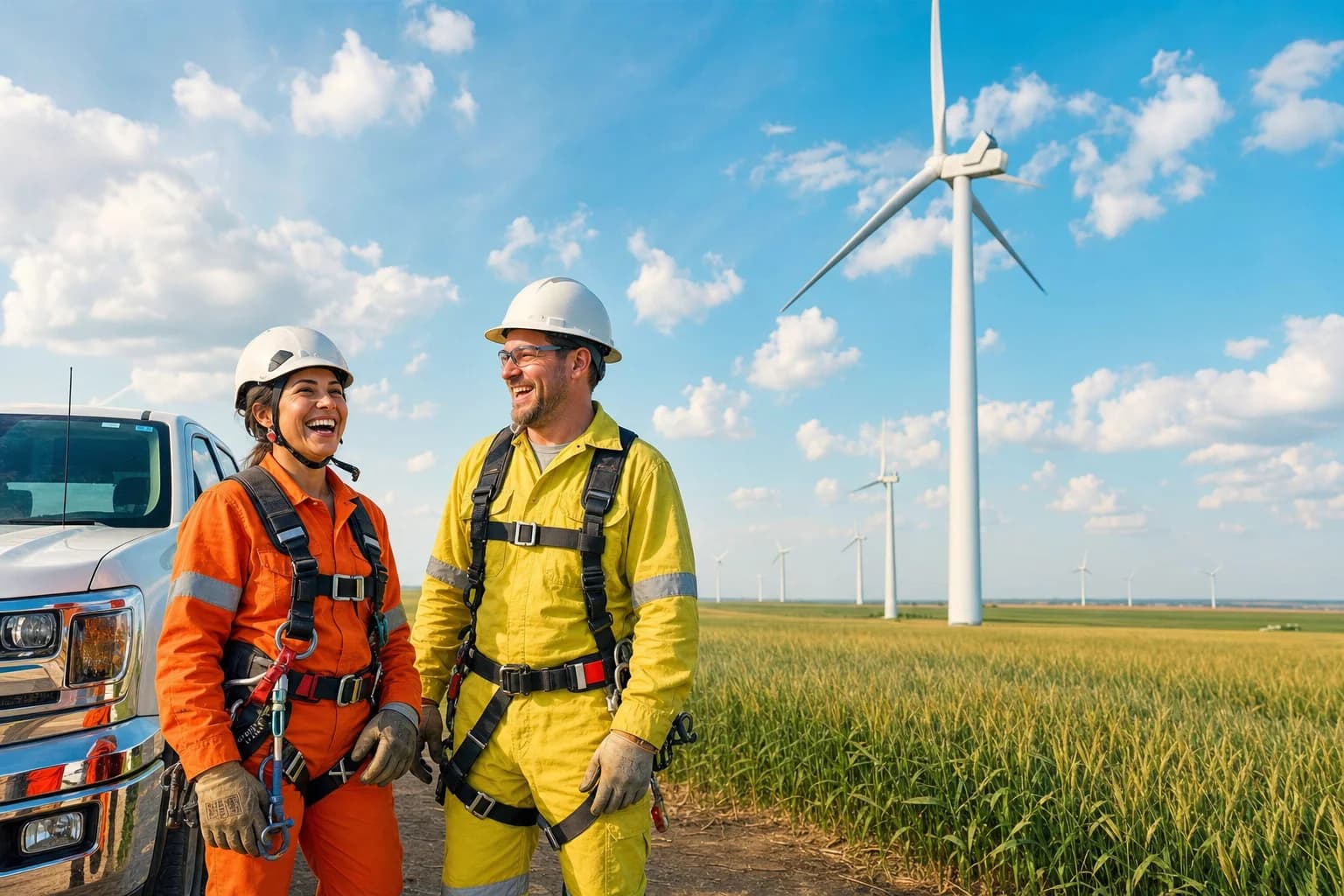
Turbines report faults through onboard monitoring. You can read those alerts remotely, but every repair means driving out and climbing. Towers commonly run 200 feet or more. You go up a ladder in a fall-protection harness with your tools, and blade repairs mean rappelling down from the nacelle. Expect cramped work inside the nacelle, outdoor weather at both extremes, and parts that can weigh 50 pounds or more.
Training routes and GWO certificates
The usual route is a technical school or community college program in wind energy technology. You can stop at a certificate or go on to an associate degree. Good programs have a training turbine on site. Coursework covers electrical and hydraulic maintenance, braking and mechanical systems, PLCs, tower climbing, rescue, first aid and CPR. After you're hired, the employer or turbine manufacturer trains you on the models you'll maintain.
No state license is required, but the industry runs on Global Wind Organisation (GWO) standards. Basic Safety Training covers first aid, manual handling, fire awareness and working at height, with sea survival added for offshore work. Basic Technical Training adds mechanical, electrical, hydraulic, bolt tightening and installation modules. GWO itself says BTT does not qualify you to do that work unsupervised. It gets you ready for company training.
Travel, schedules and who hires
Wind farms sit in rural areas or offshore, so you go where the turbines are. Most techs work full time and may be on call evenings and weekends. Offshore jobs can keep you away from home for days or weeks at a stretch. If you want to sleep in your own bed every night, look hard at how far the sites are before you take the job.
BLS counts about 11,800 wind tech jobs in 2025. Wind power generation companies employ 42 percent. Self-employed techs and line construction contractors each account for 15 percent, and industrial machinery repair firms for 12 percent. Turbine makers such as GE Renewable Energy, Vestas, Siemens Gamesa, Nordex and Enercon, along with owner-operators such as Avangrid, Ørsted, Acciona and RWE, sit on GWO's North America Committee.
Job outlook
BLS projects wind tech employment to grow 30 percent from 2025 to 2035. The average across all occupations is 3 percent. That works out to roughly 3,500 new jobs and about 1,500 openings a year once you count people retiring or leaving the trade. BLS links the growth to rising electricity demand driving new turbine construction. The occupation is small, so one regional build-out or slowdown can shift local hiring fast.
Pay
USD a year, before tax. The first row is the BLS Occupational Outlook Handbook range for wind turbine technicians, May 2025 (median $64,120). The other rows are our renewables and solar category, built from BLS OEWS May 2025 data, wage-indexed to 2026, with state figures modeled. That category includes solar trades. Industry, offshore work, travel and per diem, and on-call time all move pay. Refer to the Renewables & Solar salary guide for figures from live adverts.
What you need
- Postsecondary trainingBLS lists a postsecondary nondegree award as the typical entry credential. That usually means a wind energy technology certificate, and some techs earn an associate degree.
- GWO Basic Safety TrainingThe modules are first aid, manual handling, fire awareness and working at height. Sea survival is added for offshore work. Most major turbine makers and owners recognize the certificate.
- GWO Basic Technical TrainingThe modules are mechanical, electrical, hydraulic, bolt tightening and installation. The combined mechanical and electrical delivery takes 16 hours, and bolt tightening takes 8.
- Comfort at heightYou climb ladders on towers of 200 feet or more in a harness, carrying tools. Some jobs mean rappelling down blades.
- Strength and staminaYou'll lift parts and tools weighing 50 pounds or more and work in tight spaces inside the nacelle.
- Willingness to travelSites are rural or offshore. Offshore jobs can mean days or weeks away from home, and on-call evening and weekend work is common.
How to get there
- Before hireEnroll in a wind energy programPick a technical school or community college program in wind energy technology, preferably one with a training turbine on site.
- During schoolEarn GWO safety and technical modulesComplete Basic Safety Training, then the Basic Technical Training modules. Many schools build these into the program.
- After trainingGet hired as an entry-level techApply to turbine makers, wind farm owners, service contractors and line construction firms. GWO's entry-level framework sorts new techs into pre-assembly, installation, or operations and maintenance.
- First yearLearn your employer's turbinesEmployer or manufacturer training covers the specific models you'll maintain, and you work under experienced techs while you learn.
- Year 2 onwardSpecializeMove into troubleshooting, blade repair, high voltage work, offshore crews, or site lead roles as you build experience.
Open now on ElectricalRoles.com

Questions people ask
Do you need a license to be a wind turbine technician?
BLS says certification is not mandatory for wind techs. In practice, employers usually tell you which certificates they need, and GWO Basic Safety Training is the common baseline. Typical topics include electrical safety, tower climbing and self-rescue.
How tall are the towers you climb?
BLS says tower ladders usually run at least 200 feet. You climb in a fall-protection harness while carrying tools, and blade repairs mean rappelling down from the nacelle.
What does GWO Basic Technical Training cover?
It covers basic hydraulic, mechanical, electrical, bolt tightening and installation tasks, plus the hazards of stored energy in a turbine. GWO is clear that it does not qualify you to do that work unsupervised. It gets you ready for company-specific training.
How much do wind turbine technicians make?
BLS reports a median of $64,120 in May 2025. The lowest 10 percent earned under $49,230 and the top 10 percent earned over $92,460. Industrial machinery repair firms paid the highest industry median BLS lists, $70,670.
Is offshore wind work different?
Offshore techs need GWO Sea Survival training on top of the onshore modules. Offshore jobs can keep you away from home for days or weeks at a time.
Is there demand for wind techs?
BLS projects 30 percent employment growth from 2025 to 2035 and about 1,500 openings a year. The occupation is small, at about 11,800 jobs in 2025, so local hiring depends on where new projects get built.
Sources
- U.S. Bureau of Labor Statistics: Wind Turbine Technicians, Occupational Outlook Handbook
- Global Wind Organisation: Basic Safety Training Standard
- Global Wind Organisation: Basic Technical Training Standard
- Global Wind Organisation: Bolt Tightening module in BTT
- Global Wind Organisation: Entry Level Wind Technician Framework
- Global Wind Organisation: North America