
What Does a Substation Technician Do? Pay, Training & Outlook
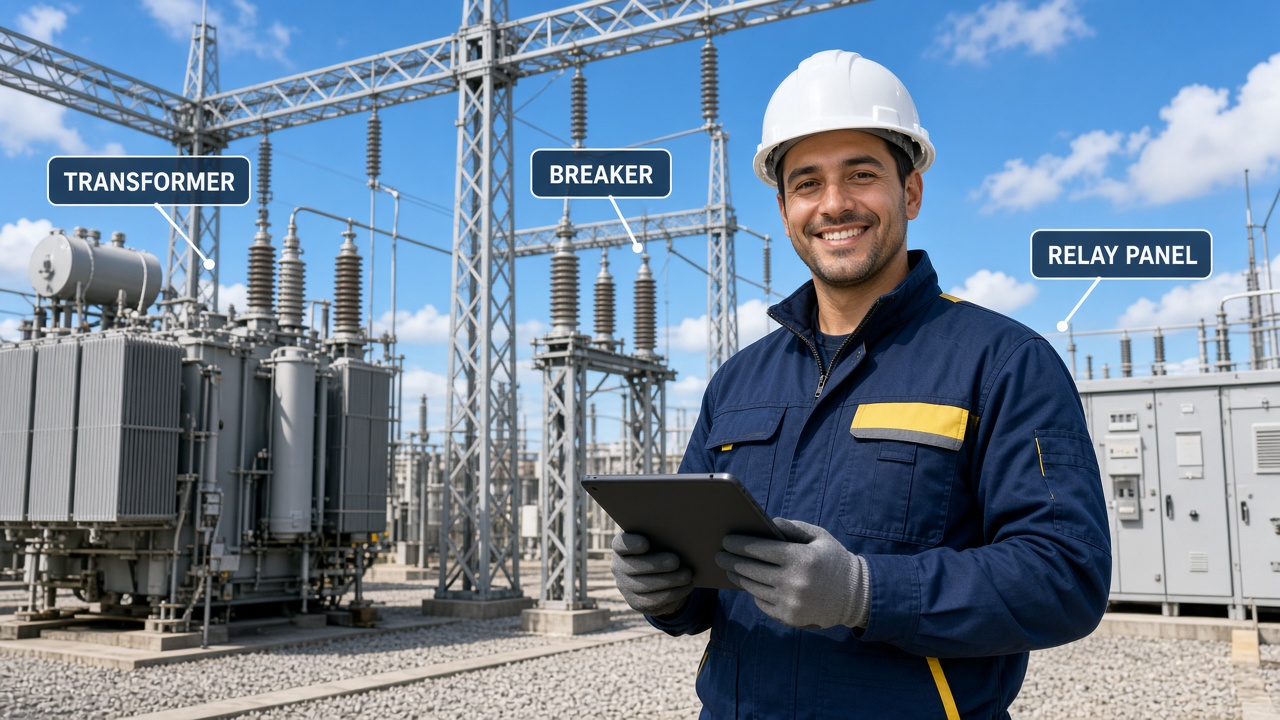
Substation technicians keep transformers, breakers and relays running. Here's what the job involves, real US and Canadian pay, and how to get in.
Drive past a substation and it looks like nothing much is happening. A fenced yard of gravel, steel and humming equipment, maybe a small brick building in the corner. But that yard is where the grid changes gears. High-voltage power from transmission lines gets stepped down, switched, protected and sent out to neighborhoods, factories, hospitals and, increasingly, data centers.
Somebody has to keep every piece of that yard healthy. That's the substation technician, and it's one of the most underrated careers in the electrical world. It pays very well, it's hands-on without being purely physical, and it's sitting right in the path of the biggest grid build-out North America has seen in decades.
In this series we've already covered relay technicians, who specialize in protection systems, and power system operators, who run the grid from the control room. The substation technician sits between them: the generalist who looks after the whole yard.
What a substation technician actually does
The City of Roseville in California describes the job neatly in a recent posting: the installation, testing, maintenance, calibration, repair and modification of electrical, electronic, communication and protective relay equipment in its substations, including protective relays, SCADA and communication systems, power transformers and breakers.
In practice, a typical month might include:
- Transformer maintenance. Inspecting power transformers, checking gauges, cooling fans and bushings, pulling oil samples for analysis, and running electrical tests to catch problems before they become failures.
- Breaker testing and repair. Circuit breakers are the muscle of the substation. Techs run timing and contact resistance tests, service mechanisms and replace worn parts so breakers open exactly when they're supposed to.
- Switching. Following written switching orders, often in coordination with the system operator, to isolate equipment safely so crews can work on it. This is a high-trust part of the job.
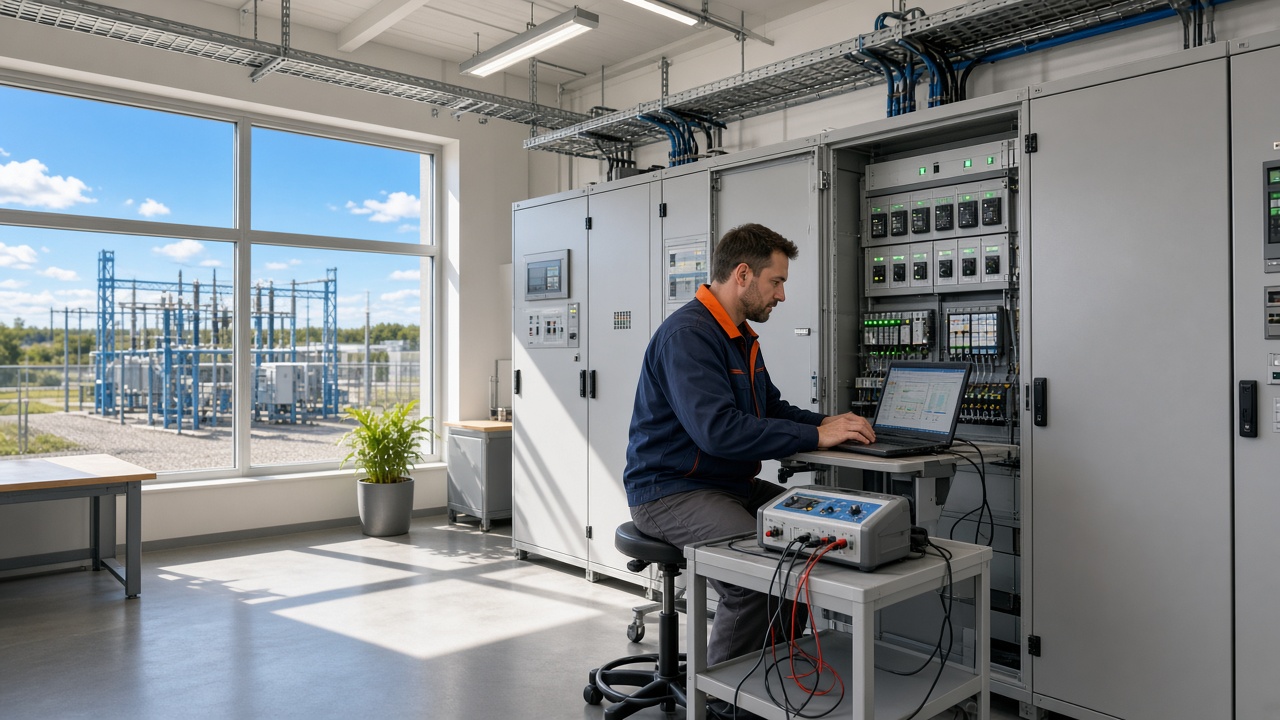
- Relay and control work. Supporting functional checks of protective relays and control schemes. Relay specialists usually handle the deep settings work, but a strong substation tech understands what the panel is doing and why.
- SCADA and communications. Keeping the remote terminal units, communication links and sensors working so operators can see and control the station remotely.
- Batteries and DC systems. The station battery bank powers protection and control when everything else goes dark, so it gets regular testing.
- Inspections and records. Walking the yard, using infrared cameras to spot hot connections, and documenting everything. Utilities subject to NERC rules must maintain protection systems on set intervals under the PRC-005 standard, and that paperwork is part of the job.
- New construction and upgrades. Installing and commissioning new transformers, breakers, capacitor banks and control buildings when stations are built or expanded.
A smaller utility posting from the City of Rocky Mount, North Carolina, lists much the same mix: testing and repairing high-voltage transformers, circuit breakers, reclosers, capacitors and voltage regulators, participating in switching, and maintaining protective relays and SCADA, with on-call duty every other week.
That on-call piece is real. When equipment fails at 2 a.m., substation techs are part of the response. It's also where a lot of the overtime comes from.
Substation tech vs. relay tech vs. electrician
People mix these up, so here's how I'd separate them:
- Substation technician: the broad maintainer of the station. Transformers, breakers, switches, batteries, SCADA, switching, inspections.
- Relay technician: the specialist in protection and control, testing and setting the relays that decide when breakers trip.
- Testing and commissioning electrician: often works for a contractor or testing firm, proving new equipment before it's energized. Our testing and commissioning guide covers that path.
Plenty of people move between all three over a career, and the best substation techs I know have a foot in each.
What substation technicians earn
United States:
The closest federal category is "electrical and electronics repairers, powerhouse, substation, and relay." According to the Bureau of Labor Statistics, the median annual wage for this group was $103,020 in May 2025, compared with $50,980 for all occupations. Across the wider electrical and electronics repairer family, those working in utilities had a median of $105,740.
Real postings show how wide the range can be by region and employer:
- City of Roseville, California: an Electric Apprentice Substation Technician posting in 2026 paid $50.25 to $82.23 an hour, plus up to $2,490 a month in health and welfare benefits and a CalPERS pension.
- City of Rocky Mount, North Carolina: Substation Technician I and II roles list $26.59 to $41.89 an hour, with a Class A CDL required.
My read: entry pay varies a lot with local cost of living, but once you're experienced and trusted with switching and testing, six figures is a very realistic target in most of the US, before overtime.
Canada:
In Canada, substation work usually falls under the power system electrician trade (NOC 72202). Job Bank lists a national median of $46.55 an hour, with a high of $60.00. Provincial medians include $51.64 in Alberta, $50.99 in British Columbia and $50.85 in Ontario. And 99.7% of workers in the occupation receive at least one non-wage benefit, which tells you most of these are stable utility jobs with pensions and health coverage.
How to become a substation technician
There's no single license for this job in the US, so employers lean on a mix of training, experience and certifications. The BLS notes that workers in this field may gain experience by first working as electricians. Here are the common routes.
In the United States
- Utility apprenticeships. Many public and investor-owned utilities run substation or "station electrician" apprenticeships. Roseville's program accepts candidates with a high school diploma or GED and places them at different levels depending on prior experience, with one year of high-voltage maintenance experience preferred.
- Electrician first. Plenty of techs start as inside or industrial electricians, then move to a utility or a testing firm once they've got the fundamentals.
- Technical college. Two-year electrical technology, electronics or power systems programs give you a head start on theory, and many utilities recruit from them. Lineworker programs can be another doorway, especially at smaller utilities where roles overlap.
- Testing firms and NETA certification. Independent testing companies are a fast way to see a huge variety of substation equipment. The InterNational Electrical Testing Association certifies techs in four levels: Level 2 requires two years of related experience plus 40 hours of safety and 160 hours of electrical training, Level 3 requires five years, and Level 4 requires ten. NETA describes Level 3 techs as capable of performing electrical power switching. Two or more years of electrical technical education can count for up to one year of experience.
In Canada
- Alberta's Power System Electrician trade. This is a designated four-period apprenticeship covering power generation, substation equipment, protection and control, and metering. Alberta's Tradesecrets lists about 1,560 to 1,590 work hours plus seven to eight weeks of classroom training per period, at NAIT or Lethbridge Polytechnic. Apprentice pay starts at a minimum of 50% of the journeyperson rate and rises to 75% by the final period.
- Utility programs. BC Hydro's Apprentice Electrician program is a 48-month paid apprenticeship with 10 weeks of in-school training a year. Apprentices usually start in substations, move to generating stations, work at three or four locations around the province, and earn 75% of the journeyperson rate from the start. You'll need English 12, Pre-calculus 11 and Physics 11, a Class 5 license and normal color vision.
- Other provinces train substation electricians through utility-run apprenticeships and electrician trades, so check your provincial utility's careers page and apprenticeship authority.
Skills that get you hired
- Strong fundamentals. Three-phase power, transformer theory, reading one-line diagrams and schematics.
- Comfort with test equipment. Insulation resistance testers, breaker timers, transformer turns ratio sets, and increasingly, laptop-based test software.
- Safety discipline. Lockout/tagout, switching procedures, arc flash awareness and confined space work.
- Digital literacy. Modern stations run on microprocessor relays, fiber communications and SCADA. Techs who are comfortable with laptops and networks are in short supply.
- A driver's license, sometimes a CDL. Rocky Mount requires a Class A CDL, and many utilities expect you to drive large trucks between sites.
Practical tips if you want in
- Polish your math and physics. Utility apprenticeships screen for it, and the theory never stops being useful.
- Get any high-voltage exposure you can. Even a year on a commercial or industrial crew working on switchgear makes you a stronger applicant.
- Start your NETA path early if you're joining a testing firm. Certifications follow you from employer to employer.
- Be open to moving. Utilities with the most openings are often outside big cities, and programs like BC Hydro's expect you to relocate during training.
- Set up job alerts. Utility postings often open for short windows and close after a set number of applications. Roseville's posting capped at the first 200 applicants.
The outlook: excellent, and here's why
BLS projects employment of powerhouse, substation and relay repairers to grow 10% from 2025 to 2035, much faster than the 3% average for all occupations, adding about 2,000 jobs. In BLS's own words, "increased strain on the electrical power grid is expected to increase demand" for this work.
I think that may even undersell it. Every new data center connection, transmission line and battery project ends in a substation. Utilities are lining up record capital plans, from Duke and Fortis to Canada's $115 billion grid plan, and grid operators are now proposing faster ways to connect big new loads. On top of that, a lot of experienced techs are approaching retirement, and the transformer crunch means keeping existing equipment running longer is more valuable than ever.
Put simply: more stations, more equipment, more data, and not enough people who know how to look after it all. That's a great place to build a career.
If this sounds like you, browse substation, utility and electrical jobs across the US and Canada and take the first step.